Israeli strikes on Lebanon are wrong and should stop, PM says

 BBC
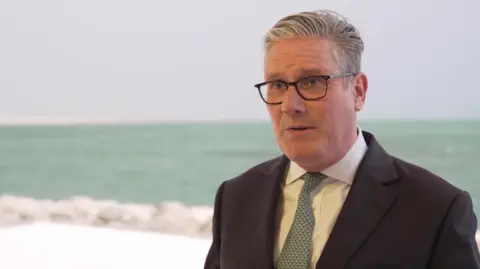
BBCIsraeli attacks on Lebanon are "wrong" and "should stop", Sir Keir Starmer has said during a three-day visit to the Gulf region.
Speaking to ITV's Talking Politics podcast, the prime minister said it was "a matter of principles" rather than a "technical" question over whether the strikes breached Tuesday's ceasefire deal.
The Iranian deputy foreign minister told the BBC the strikes on Wednesday - which according to Lebanon's health ministry killed 303 people - were a "grave violation" of the ceasefire agreement, but Israel said Lebanon was not covered by the truce.
Israel's Prime Minister Benjamin Netanyahu has told his cabinet to begin negotiations with Lebanon "as soon as possible".
Sir Keir said the UK had not seen the details of the ceasefire and that it was therefore "hard to say" if Israel's strikes breached the deal.
At the start of the conflict with Iran, the UK refused the US permission to use British air bases for its initial strikes against Iran, but later allowed them to be used for defensive operations.
US President Donald Trump has fiercely criticised the UK, as well as other allies, for not getting more involved in the conflict.
The prime minister told ITV that he did not want to involve the UK in "something which didn't have a lawful basis or a clear thought-through plan".
Asked if he was sure that British bases were only being used by the Americans for defensive missions, Sir Keir said "we are monitoring that very clearly".
The prime minister has arrived in Qatar as part of his three-day visit to the Gulf, after travelling to Saudi Arabia, UAE and Bahrain over the last few days.
Starmer also had a call with Trump following his arrival in Qatar, where they spoke about the reopening of the Strait of Hormuz, and discussed "the need for a practical plan to get shipping moving again as quickly as possible."
A Downing Street spokesperson said Trump and Starmer "agreed that now there is a ceasefire in place and agreement to open the Strait, we are at the next stage of finding a resolution."
The two leaders agreed to speak again soon, Downing Street added.
Earlier in the day, Foreign Secretary Yvette Cooper called for the Strait to be fully reopened after ships in the Gulf were warned by the Iranian navy that those without permission to pass through faced attack.
Cooper told the BBC there should be no tolls or restrictions on the critical shipping route, as ships face uncertainty on possibly making payments to Iran to secure safe passage.
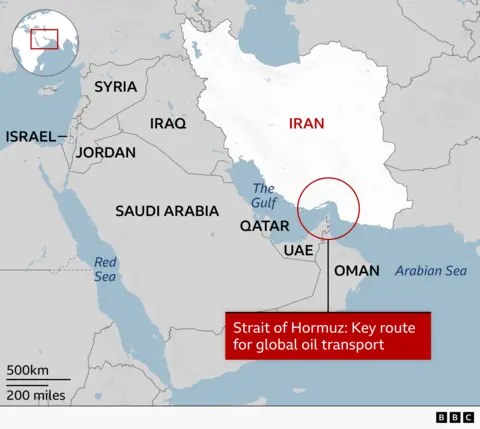
A fifth of the world's energy shipments usually transits through the Strait of Hormuz, which has been effectively closed by the threat of Iranian attacks in retaliation to a bombing campaign by the US and Israel.
The conflict has caused the price of crude oil to spike, with sharp increases in petrol and diesel costs, leading to concerns about the cost of living in countries across the world.
Cooper delivered her annual speech on UK foreign policy priorities on Thursday evening, describing the Strait of Hormuz as an "international shipping route, a transit route for the high seas."
Speaking at Mansion House, she said no country can close those routes, as "it goes against the fundamental principles of the law of the sea."
"Today, we know more than ever, that freedom of navigation is the underpinning of global trade. And it matters for every sea, every ocean, every strait," Cooper said.
"Every country has a stake in this, every industry is affected by it."
Defence Secretary John Healey, speaking at a press conference in Downing Street, said the introduction of any "pay for passage tolls" would create a "potential principle that could be used and abused by others elsewhere".
Ministers accept the real decisions lie in the hands of the US and Israel - and the foreign secretary has urged them to include Lebanon in the ceasefire deal.
Cooper said she was "extremely concerned about the escalation of Israeli strikes" on Wednesday, adding: "We want to see Lebanon urgently included as part of the ceasefire, building on the ceasefire that's been announced, we want to see an end to the hostilities in Lebanon."
Pakistan - which acted as an intermediary in the ceasefire talks - and Iran said the deal covered Lebanon, where Israel has been fighting the Iranian proxy Hezbollah.
But Israel and the US have said the two-week ceasefire does not include Lebanon.
The foreign secretary will also visit the International Maritime Organization on Thursday in a show of support for the organisation's efforts to help ships and seafarers currently trapped in the waterway.
Last week, the UK chaired talks involving more than 40 countries on how to unblock the Strait of Hormuz, with all participants agreeing that the war had to end first.
Cooper said Iran had been able to "hijack" the international shipping route to "hold the global economy hostage" following the virtual summit, which the US was not involved in.
The US has repeatedly accused allies of not doing enough to secure the shipping route or to support its war effort, leaving the UK and other nations weighing how to contribute to securing the critical waterway without becoming involved in the wider war.
Iran has attacked several vessels in response to the war waged against it by the US and Israel, disrupting energy exports and sending global fuel prices soaring.
Prior to the ceasefire announcement on Wednesday, Trump said it was for other nations to "build up some delayed courage" and reopen the route.
Liberal Democrat leader Sir Ed Davey said Israel's strikes on Lebanon were "undermining any hope of peace".
He urged the government to "halt all UK arms exports to Israel" and support plans to disarm Hezbollah, the Iranian-backed armed group in Lebanon.
Green Party leader Zack Polanski said the government should do more to stop Israel behaving "like a rogue state", including withdrawing from its trade deal with the country and introducing sanctions.

Sign up for our Politics Essential newsletter to keep up with the inner workings of Westminster and beyond.
