Book dubbed 'the work of angels' may have been made in the Highlands

 Getty Images
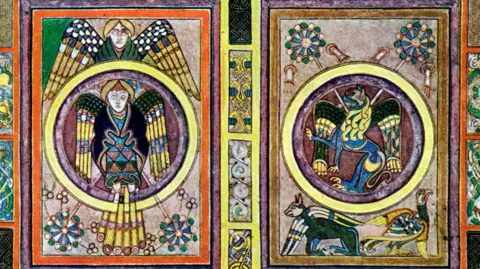
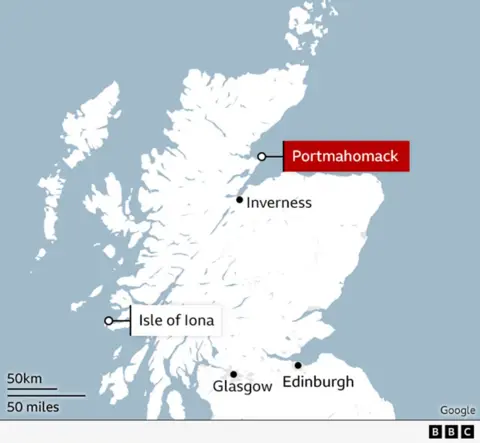
Medieval monks in Easter Ross - and not the tiny island of Iona - may have created the intricately decorated 1,200-year-old Book of Kells, according to researchers.
The illuminated manuscript depicting the four Gospels of the Christian New Testament has been described as "the work of angels" due to the complexity of its lettering and illustrations.
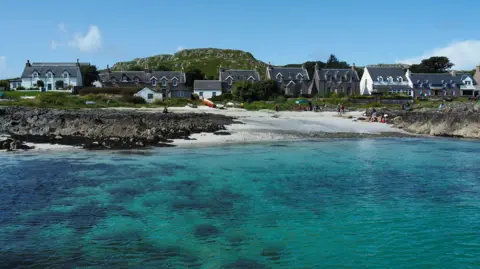
Its origins are a mystery, but it was thought to have been made on Iona before being taken to Kells in Ireland by monks who survived a Viking attack on the Hebridean isle.
But a new project will explore the possibility it was created at a monastery in Portmahomack where there was a workshop turning animal hides into vellum - a fine parchment used for writing on.
 Getty Images
The workshop, called a parchmenarie, was excavated by archaeologists in the late 1990s and early 2000s.
Finds included bone pegs for stretching vellum as it dried, and tools such as knives and pumice stones for scraping and smoothing animal hides.
Also unearthed were fireplaces containing evidence of the burning of toothed wrack seaweed to form soda ash. When mixed with water, the soda removed hair from the skins.
A 1,500-litre stone-lined tank for soaking the hides in was found nearby.
The Society of Antiquaries of Scotland has awarded £2,779 to master craftsman Thomas Keyes to conduct an experimental archaeology project later this year.
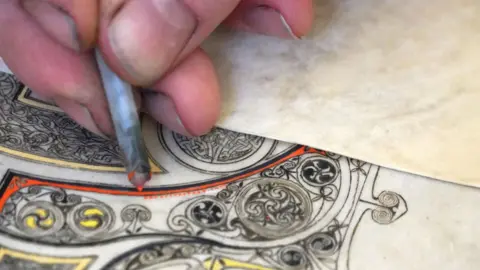
He hopes to gain a better understanding of the vellum workshop by reconstructing its water tank and using it to make vellum.
Keyes worked on a previous project that explored medieval techniques to produce manuscripts.
The Society of Antiquaries of Scotland said the Highland site was the only known example of an early medieval vellum-working site in Northern Europe.
It added that Portmahomack had physical evidence, while Iona's was largely documentary evidence.
Dr Helen Spencer, head of research at the Society of Antiquaries of Scotland, said there was other evidence to back the Portmahomack's claim.
"The footprints of craftworking buildings were found along with evidence for different stages of production, including the creation of vellum, pigments for the pages and glass stud mounts for the cover and bindings," she said.
"Incredible gospel books were definitely produced at Portmahomack and Thomas Keyes's experiment could bring us closer to knowing whether the Book of Kells was one of them."
 Norman Strachan
Keyes said Portmahomack's parchmenarie was "both unique and unusual".
"Usually, lime is used in the production of vellum parchment, but this is not found locally," he said.
"Seaweed lye may have been used instead which is a less caustic process where bacteria grow in the solution to process hides.
"Pages from some manuscripts from the period, including the Book of Kells, have numerous pock mark holes which could be evidence of bacteria eating through the hides as they were being processed."
Keyes added: "Reconstructing the hide soaking tank will shed light on the finer details of this process and the parchment samples produced can be compared directly with original manuscripts."
The results will be published online by Tarbat Discovery Centre and shared in a public lecture in late 2026.
Calum Thomson, chair of Tarbat Historic Trust, said the project was "incredibly exciting".
The funding forms part of a round of awards totalling £20,769 and involving nine projects.
The Book of Kells is displayed at Trinity College Dubin where it has been kept since 1661.
