School heads struggle to find work-life balance amid 'exhausting' pressures

 BBC
BBCHead teachers are struggling to find a work-life balance as they describe the pressures in their schools as "exhausting and untenable".
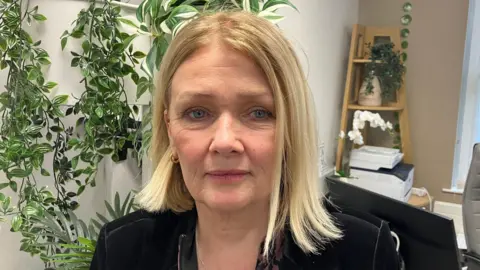
Bernie Davis, the principal of a special school in Belfast, said there is a "lack of support" as staff are expected to "make decisions about things that you've never been trained in or never experienced before".
The National Association of Head Teachers (NAHT) has declared a "trade dispute" with the Department of Education (DE) over workload and school maintenance and funding pressures.
The DE said the decision to enter the dispute was "disappointing".
The NAHT called the role of a school principal in Northern Ireland "unsafe, unsustainable and professionally indefensible".
They said that there was a "breach of duty of care owed to school leaders".
In a statement the DE said it was "committed to addressing the issue of teacher and school leader workload and ensuring that they can focus on what matters most – teaching, learning and supporting pupils".
 PA Media
Davis has worked at Park Special School in Belfast for more than 30 years and been the principal for 10.
Her work day starts at 07:30 GMT and she leaves school around 17:00 GMT - but often finds herself working again after dinner and waking up during the night.
"I have to say over the last number of years I've really noticed it and it's exhausting and untenable."
Davis said there are "great demands" especially in Special Educational Needs (SEN) provision as "they're going into mainstream as well and we'd be asked for a lot of advice".
She added that there is an administrative burden now, and their role in "leading learning, teaching and safeguarding in schools is nearly gone and forgotten about".
"To be honest with you, it is an isolated profession as well and all this has led to a downward spiral," she said.
"We need ring-fenced budgets, we need immediate intervention into SEN provision and we need support in our roles just to reduce the admin burden that we have."
Schools becoming 'increasingly complex places'

Victoria Hutchinson, the principal of Strandtown Primary School in east Belfast, added that schools had become "increasingly complex places" and her workload had "significantly increased" as resources and support for schools had dropped.
"We've seen impoverished support for SEN services, there are serious maintenance issues," she said.
Hutchinson said that she had been trying to get a leaking roof and doors in her school replaced for almost five years.
"That is something that is worsening with every storm and with every rainfall," she said.
"And the implications for ensuring pupil and staff health and safety within the building, which we will do, that becomes a significant daily workload.
"To ensure that you make the building fit for purpose when there are long-standing unaddressed maintenance issues."
A recent assembly report said many schools in Northern Ireland were "in a state of disrepair," and it would take up to £800m to fix them.
 Getty Images
Hutchinson said school heads have no "off-switch" and it affects their mental health, work and family life.
"There is never a moment when you aren't ruminating or reflecting or considering school-related issues," she said.
She said that families of pupils are facing "massive" challenges, like "navigating childcare, access to health services, financial hardship".
And that means they often turn to the school for help.
"School leaders are the emotional landing point for all of this," she added.
"There is never an off button or an off-switch that you can just shelve that when the working day comes to a close, it doesn't.
"Because there aren't agencies or supports there to say look 'here's what to do in this situation,' or 'here's how to respond' you are working through that until the point you have something.
"It is a continual job."
Hutchinson said she felt there was acknowledgement that heads faced an unsustainable workload, but without practical intervention it was "meaningless".
What change do heads want?
 Joanne Whyte
Joanne Whyte is the president of the NAHT and has been principal of Clarawood Special School in Belfast for several years.
Whyte said the education minister and department are "working towards an improved curriculum, an improved situation in our schools, but unfortunately the finances are not there to be able to push that forward".
She said the department needs to "sit down with us and hear us".
"If a principal was able to put a ceiling on their hours of 40 or even 45 hours that would be a huge win for our profession."
The NAHT has told the department "school leaders are carrying risks they cannot control and responsibilities they cannot safely discharge".
In an unusual move, they have declared a trade dispute and have called for talks mediated by the Labour Relations Agency.
They have called for DE to introduce immediate measures to reduce heads' workload including pausing new initiatives, "emergency intervention" to address SEN pressures, clear working time guidance and increased school maintenance.
They have said that unless the employers act within 14 days, "we will proceed to an indicative ballot for industrial action on Wednesday 4 March 2026".
The DE said: "The minister and department have shown undoubted commitment to tackling excessive workload and would urge the NAHT to work with the Department and the Teachers Negotiating Committee (TNC) to agree a resolution to this issue."
