'Can't afford lost wages': India's voter roll revision is worrying migrant workers

 Abhishek Dey
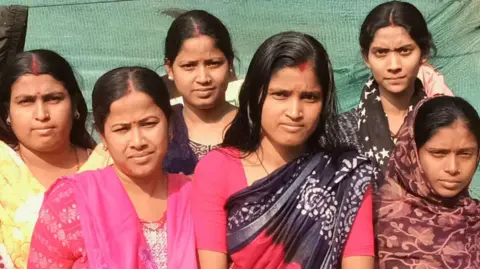
A sense of anxiety grips Rangpuri Pahari, a slum in India's capital Delhi.
The neighbourhood houses thousands of migrant workers who have lived hand-to-mouth for decades, mostly employed in the unorganised sector as domestic staff, cooks, mechanics, car washers and construction labourers.
Now they fear they'll have to make sudden - and costly - trips home to keep their names on India's electoral rolls.
On 4 November, India began a major exercise to revise electoral rolls across 12 states and federally administered regions.
Known as the Special Intensive Revision (SIR), it covers nearly 510 million voters - or more than half of the country's 970 million electorate.
India's Election Commission (EC) says the aim of the exercise is to ensure that no eligible voter is excluded and no ineligible name remains on the rolls. A similar controversial exercise was carried out in India's Bihar state recently.
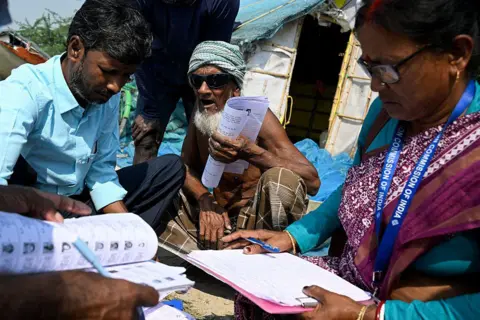
As part of this exercise, polling booth-level officers visit households across towns and villages, collecting personal identity details and voter card numbers.
For most migrant workers, an unplanned trip home means extra costs and lost wages.
"My employers approve time off only during elections and festivals. If I take leave now, I will lose my salary. I can't afford that. And someone else could replace me," Anjali Mondol, who works as a domestic help, told the BBC.
Similar concerns were echoed by others in the slum. Subhashri Doloi, also a domestic worker, says: "I was saving money to travel home in a few months to cast my vote. But if I use that money now, how will I go again during the election?"
 AFP via Getty Images
Some worry about the gaps in their official documents - a common problem across India, especially in rural areas.
Kusum Devi, who works in a garment factory in Delhi, is a registered voter in her village in Uttar Pradesh - one of the states where the SIR is ongoing. But her Aadhaar, a national unique identification number, shows her as a resident of Delhi.
"There has been no problem so far, but I don't know what will happen now," she says.
Workers also worry that the SIR could affect their access to welfare schemes. For those from West Bengal (another state where SIR is ongoing), which borders Bangladesh, there is an added fear of being asked to prove their citizenship.
Crackdowns on alleged illegal immigrants from Bangladesh are not new in India. In recent months, hundreds of people have been arrested on suspicion of being illegal migrants.
"Nobody wants to be wrongfully branded as Bangladeshi," said Yaser Ali from West Bengal, who sells utensils. "If this [SIR] helps us, we want to make sure that it is done right. But how do we do it on such short notice?"
Under the guidelines, there is a provision to fill the SIR form online but most migrant workers the BBC spoke to said they were either unfamiliar with the process or found it "too risky".
The EC has dismissed these concerns, saying the process is being carried out in the most transparent manner.
In a statement shared with the BBC, the poll panel urged voters to opt for online verification, saying the option has been introduced especially "for the convenience of those electors who are currently not at their place of residence".
The physical forms, on the other hand, can be filled up by the electors themselves or "any adult family member", by mentioning their relationship with the elector, and handed over to the booth-level officers, it said.
The EC added that it will ensure that "sufficient opportunity and time is given to the electors for filing claims and objections".
 Abhishek Dey
For the SIR, electoral rolls from 2002 to 2004 are being used as reference.
People whose names do not appear in those lists must produce one additional document - such as their birth or caste certificates, passports, school records, post-office papers and bank documents - to be able to enrol.
Those who became eligible voters or were born after the reference year must also show supporting documents for one or both their parents.
However, an order by the EC issued on 27 October says, "No document is to be collected from electors during the enumeration phase" - without giving any more details.
Some workers are hopeful. Ramdhin Prajapati, a factory worker who votes in Uttar Pradesh, says he sees SIR as a "one-time effort" he is willing to make.
Uttar Pradesh will not go to the polls before 2027 and Mr Prajapati feels there will be enough time to make corrections if things go wrong.
But that's not the case for workers from West Bengal, where elections are a few months away.
"There is hardly any time," says Uma Muniam, who works as a cook in Delhi. "There are millions of migrants like me spread across India. Will they be able to travel twice in four months - once for SIR and again for election?"
 NurPhoto via Getty Images
Rajesh Kumar, a Delhi-based trade unionist, says the poll panel needs to do more to create awareness about the process. "Most migrant workers lack job security and the SIR exercise is causing them stress," he said.
According to India's 2011 census, the most recent count, the country has around 139 million migrant workers, although the actual numbers are believed to be much higher.
"It would be useful if help desks were set up in big cities to assist these workers," Mr Kumar says.
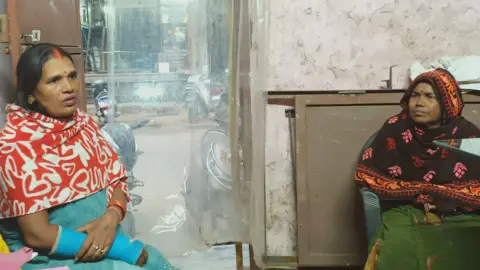
Back in Rangpuri Pahari, some neighbours had gathered at Rajendranath Mallick's home last week.
Mr Mallick, one of the few migrants travelling to his West Bengal village for the SIR, has become a go-to figure in the slum, fielding constant questions. Some want him to fill out their forms once he reaches home; others, who've already sent papers to relatives, want him to check if the process has gone through.
Mr Mallick's feedback will help his neighbours decide whether, and when, they need to make the journey themselves.
