'You can't stop once the fossil hunting bug hits'

 BBC
BBCThe East Yorkshire coast attracts thousands of tourists each year but the beaches and cliffs that make up the landscape are becoming a growing attraction for people seeking more than a day at the seaside.
On the fastest eroding coastline in Europe the lure of hidden treasures in the form of fossils is bringing people from as far away as China and the US.
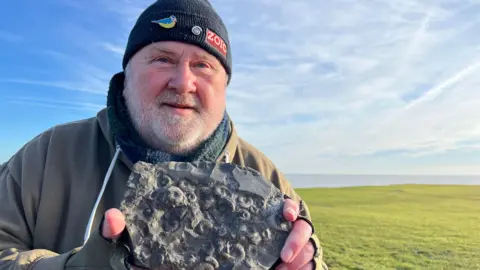
I join Harry Tabiner at Mappleton on a sunny but chilly winter's day. Between sips of tea from his flask, Harry takes great delight telling me about his finds over the years.
"I've had quite a lot of success. I've found a mammoth tusk, a woolly rhino tooth and they're pretty rare," he reveals.
"When you find something that hasn't been seen for 200 million years it's amazing. It's got the wow factor."
Harry says his interest in fossils started at four years old when his dad brought some examples home but admits "I didn't take much notice at first".
"As I got older they became more interesting and I started asking questions.
"We've had a caravan here at the coast for 35 years. It was always fantastic to get on the beach, especially with my sons, to see what we could find.
"All fossils excite me. I don't think I could ever get bored of them. Once you get the bug, it's hard to get rid of."
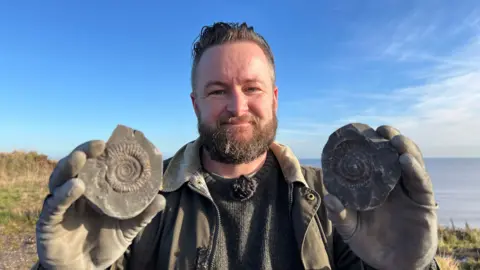
Braving the biting sea air we walk across the sand to meet fellow enthusiast Mark Kemp from Hull as he starts the search for his latest find.
Mark, who is known on social media as the Yorkshire Fossil Hunter, admits the hobby has seen growing interest with Instagram and TikTok turning the pastime into "a big thing".
"You meet some really interesting people," he says.
"I once took Hollywood actor Gary Oldman and his wife out collecting but I've also met people from as far away as China."
And what makes fossil hunting so special?
"It makes you think about what used to be here. These fossils were around when the dinosaurs roamed the land and giant reptiles ruled the ocean," Mark explains.
"If you find a fossil you know you're the first person to have ever seen it."
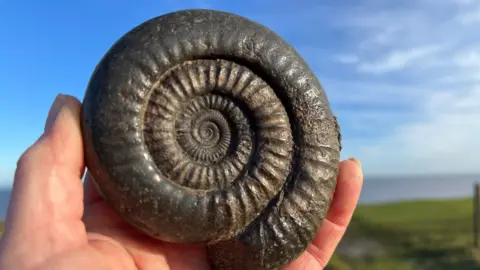
Mark uses a hammer to chip away at a smooth, round rock revealing an ammonite with its distinctive coiled shell.
With a beaming smile spreading across his face, he says: "It's a beauty."
Despite the surge in popularity, it remains illegal to remove natural materials from a beach.
The Coast Protection Act 1949 states that people are not allowed to remove sand, shells and pebbles.
Enforcement of the law is the responsibility of local councils with interpretations differing and some authorities issuing fines of up to £1,000.
Both Harry and Mark are also keen to stress the importance of safety for any would-be fossil hunters heading to the coast.
"It's great to come and get the fresh air but you need to be mindful of the dangers," Mark says.
"You need to stay away from the cliff when you're on the beach and it is so important to look at the tide times.
"You want to collect when it's falling and be back to safety before high water when the tide comes in," he concludes.
Listen to highlights fromHull and East Yorkshire on BBC Sounds, watch the latest episode of Look Northor tell us about a story you think we should be coveringhere.
Download the BBC News app from the App Store for iPhone and iPad or Google Play for Android devices
