Wall find gives glimpse of Peak's prehistoric past

 National Trust
National Trust staff have found fossils in a dry stonewall in Staffordshire that date back 340 million years.
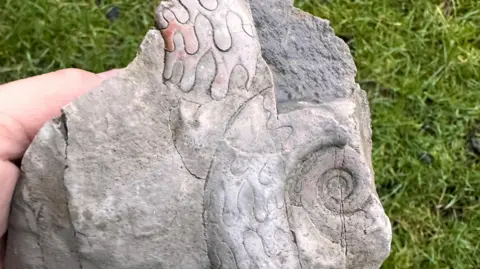
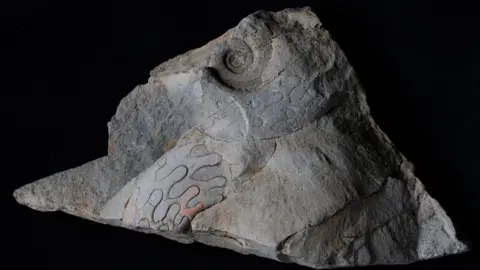
The fossilized remains of two sea creatures called goniatites were found in the White Peak - but the National Trust does not want to give away the exact location in case it leads to a surge in visitors wanting to make similar finds.
Trust rangers said the fossils really stood out because of how well preserved they were.
Ranger David Ward, who was there when the find was made, said: "I said 'have you drawn [the markings] on the rock?' because it was so intricate, these little wavy patterns."
He added: "We are really lucky because limestone is full of fossils but often they are in bits, little fragments.
"I have seen shells similar to this but not as well preserved."
 National Trust
Paleontologist Susannah Lydon, from the University of Nottingham, explained that the goniatite was a sea creature that lived in a shell similar to a squid or an octopus.
She said it would have lived in a tropical sea, and when it died it would have sunk to the ocean floor where it was fossilized.
It is similar in shape to ammonite fossils that were formed later, and are commonly found in Whitby and Lyme Regis.
"If you find a fossil in the rocks beneath your feet, you learn something about the deep history of where you are living and I think it is relevant to everyone to understand their place on the planet," Lydon said.
"I think everyone wants to know where they came from, it is part of that really big story.
"I think it is great when people find local fossils."
Ward said the fossil would be kept by the National Trust and used in talks to inspire people to make finds like it.
 National Trust