Crocuses in bloom celebrate city's Indian connection

 University of Leicester
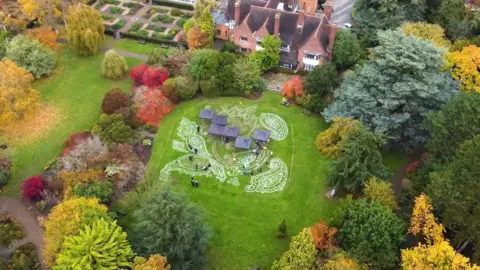
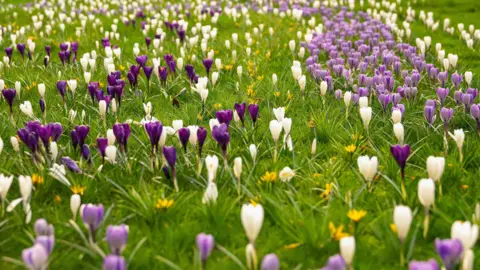
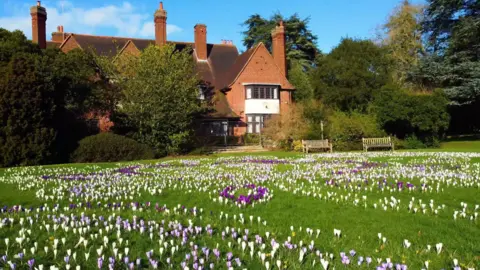
Thousands of crocuses have bloomed in a colourful display celebrating Leicester's connection to India.
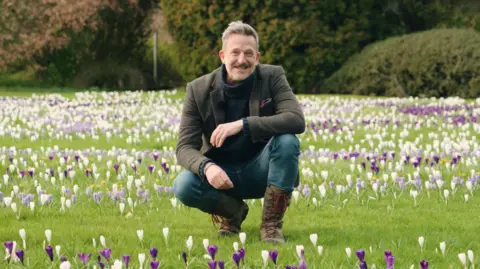
The flowers at the University of Leicester's Botanical Garden, in Oadby, were planted last year by a team of 60 volunteers led by BBC Gardeners' World presenter Nick Bailey.
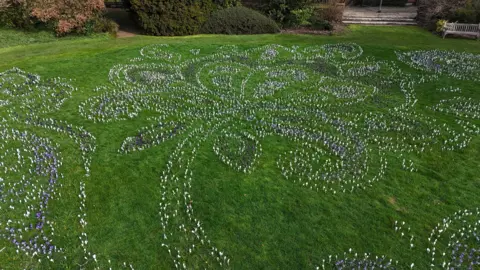
The display, roughly the size of two tennis courts, is in a paisley pattern which Bailey said he selected because of its link to India.
"In choosing this pattern we aimed to represent and celebrate the diversity of Leicester and its many communities," Bailey said.
 University of Leicester
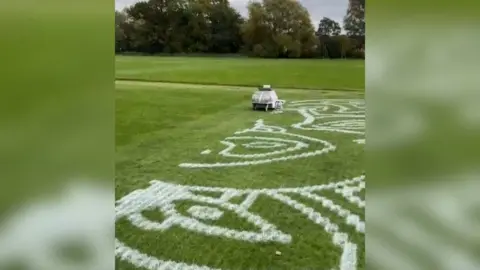
Volunteers were able to create the pattern out of gold, mauve, violet, and white crocuses through the use of a robot line marker.
The robot traced out the paisley pattern based on a licensed design, before spray paint was used to show where to put the different coloured bulbs.
Over the course of three days in October these markings were followed to plant the 40,000 bulbs.
 University of Leicester
Bailey said the paisley pattern celebrated India because although it originated from ancient Mesopotamia, it was "popularised, evolved and shared globally from India".
About a third of Leicester's population is of Indian ethnic heritage, according to the University of Leicester.
 University of Leicester
The English name for the paisley pattern used in the display comes from a town in west Scotland.
 University of Leicester
The project was funded by the Friends of the Garden, which is a paid membership association that supports the University of Leicester's Botanical Garden.
Bailey paid tribute to the association and to the volunteers for the project.
"I am incredibly grateful to the Friends, and of course, our volunteers who showed great stamina and enthusiasm to complete the planting," he said.
"Without them this wonderful project wouldn't have been possible."
 University of Leicester
Listen to BBC Radio Leicester on Sounds and follow BBC Leicester on Facebook, on X, or on Instagram. Send your story ideas to eastmidsnews@bbc.co.uk or via WhatsApp on 0808 100 2210.
