From stereotypes to 'mental load' – how do women feel about gender equality?

 Stephen Huntley/BBC
Over the past century or so, women have secured the right to vote, stand for Parliament, divorce and obtain contraception, and freedom from discrimination and for equal pay.
But while the gender pay gap has reduced, it hasn't disappeared.
And there are countless other inequalities between men and women.
How do some women feel about gender equality?
'Confidence and stereotypes can hold girls back'
 Ben Schofield/BBC
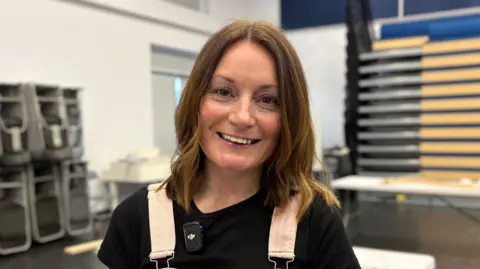
Laura Deller didn’t pick up a power tool until she was 35.
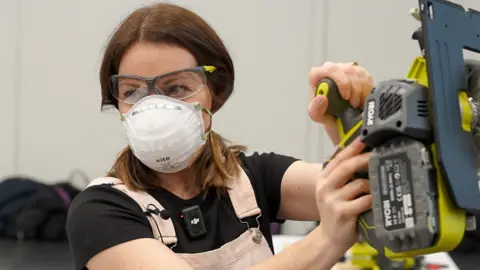
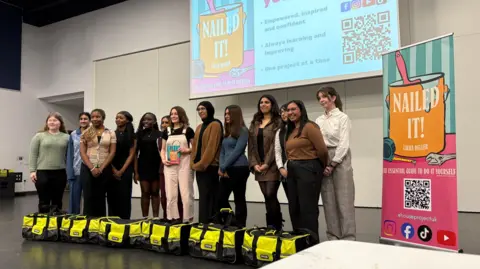
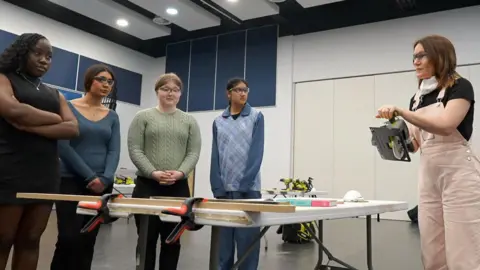
Now a 41-year-old teacher and DIY influencer, she is about to guide a dozen sixth form girls in how to clamp, drill and power-saw chunks of wood.
Through what she calls a "power hour", she wants to give the girls the confidence and know-how to "put a curtain pole up or... fix a shelf".
A hall at Bedford Academy is soon echoing with the buzz of tools taking on timber, the floor strewn with sawdust.
Deller, mum to a daughter, 10, and son, eight, believes there isn't enough female representation in DIY or trades, like plumbing and plastering.
Her @houseprojectuk social media content has about 450,000 followers, mostly women and girls.
She has also written a how-to book – Nailed It! – aimed at female readers.
 Ben Schofield/BBC
What does she think holds women and girls back?
"It can be confidence – it can be stereotypes," she says.
She advocates "smashing through those stereotypes and going 'Actually, do you know what? I can do this. I can pick up a power tool. It's not just something that's for boys, for men'".
While things have "shifted a lot in the last 20 years", she thinks there is still a long way to go.
"For our women coming forward, we need to make sure that there's equal pay; equal opportunities," she says.
'Loads of pressure' to perform better than boys
 Ben Schofield/BBC
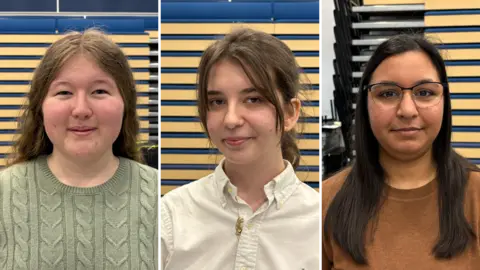
Smiling broadly, A-level student Ella, 17, says getting her hands on the tools was "empowering".
The biggest equality issue for her? "Gender stereotypes and gender roles," she says.
"Men are expected to do a lot of the work and women are not ever taught how to use power tools or anything of that sort of thing."
Beyond DIY, aspiring engineer Sara, also 17, is studying chemistry, maths, physics and history – among which are some "quite male-dominated subjects".
While set on those choices, she says she knows "a few people that were a bit wary of taking a few subjects" because there was "going to be so many boys in the class".
After 2025's A-level results, the Institution of Engineering and Technology (IET) said it was "raising concerns" because of "traditional gender gaps... in subjects like maths, physics and computing".
Female students, the IET said, made up 37.3% of A-level maths entrants and 24.1% of physics entrants.
 Stephen Huntley/BBC
Sara says sometimes "the boys take most of the attention because they're quite loud" in class.
If you're not outwardly loud, she adds, "you have to be loud in other ways, and most of the time that is through getting higher grades".
Suriya, who says she particularly enjoyed trying the circular saw, feels "loads of pressure on your back to do better" than boys.
"Definitely you have to prove yourself," she adds.
'Mental load can be overwhelming'
 Ben Schofield/BBC
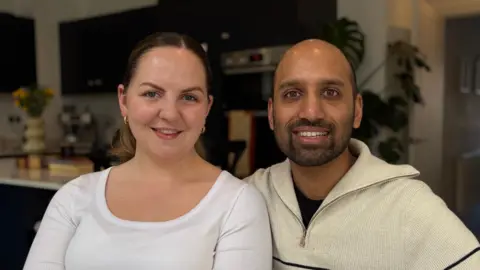
Hannah, a 33-year-old Bedfordshire mum of two boys under two, is preparing to return to work at a local church after maternity leave.
Asked about gender stereotypes, she says: "There's certainly that expectation that as the mum, you are the go-to parent; you are the primary carer".
There are points, she adds, "where that pressure can feel a bit much" and that "the mental load" is sometimes "overwhelming".
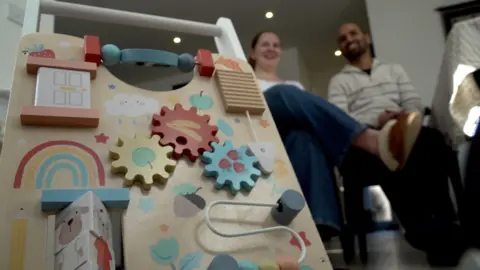
Hannah says she is "incredibly fortunate" to have a supportive husband, Asantha, who works in marketing.
His company offers enhanced paternity leave and he took five weeks off when their youngest, Noah, was born and is now taking seven weeks' leave before Noah turns one.
He's now looking forward to being "able to slow down, to be more present, to be more engaged" with his children.
"Hannah has basically spent the last couple of years looking after the children or being pregnant, so actually being able to give her some relief, being able to share the load to me – to us that is really important," he says.
 Ben Schofield/BBC
Hannah and Asantha recognise it is "quite unusual" for fathers to take so much time off.
Last year, a committee of MPs said the UK's parental leave system had "fundamental failings" and was "one of the worst statutory leave offers for fathers and other parents in the developed world".
The government is part-way through a "landmark review" of the system, looking at how to "better support working families".
Launching the review, it said one in three new fathers didn't take any paternity leave because they couldn't afford to and that take up of shared parental leave had been "very low".
What holds families back?
"Finance," Asantha, 40, says quickly.
Hannah adds that it's "vital that we look at both parents" and "ultimately to support the whole family unit".
'You're expected to be nurturing, but also assertive'
 Ben Schofield/BBC
There has been some progress. Between 1997 and 2025, the gender pay gap – the difference between men's and women's average earnings – shrank in the East region from 17.7% to 7.5%.
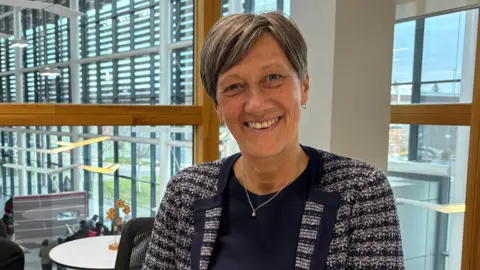
West Herts College principal and chief executive Gill Worgan, 59, says her career has "been a tough road at times".
Her journey has taken her from a council house in Risca, Caerphilly county, to leading a college of more than 10,000 students.
She says while "now it's much better", there are still "stereotypical attitudes that men are more capable; men are better for those senior roles".
She recalls experiencing "quite an overwhelming feeling" of imposter syndrome.
"You have to take a deep breath and you have to have that confidence to cope with it," she says.
Women, she adds, are "expected to be nurturing" but "at the same time you're expected to be assertive, decisive and often when you are assertive, it's sometimes seen as aggressive, where a male counterpart can be assertive and it's seen as positively decisive".
In her career there were "definitely instances" when she felt "at a disadvantage because I was female in a very male dominated environment".
Her advice to young women?
"Be leaders wherever you can be one: in your friendship group, throughout your hobbies, in any environment, in any situation where you can demonstrate leadership and you can experience leadership, do it."
BBC Politics East will be broadcast on Sunday 15 March at 10:00 GMT on BBC One in the East of England, and will be available after broadcast on BBC iPlayer.
Follow Beds, Herts and Bucks news on BBC Sounds, Facebook, Instagram and X.
