Le Tocq pleads guilty: What happens next?

 BBC
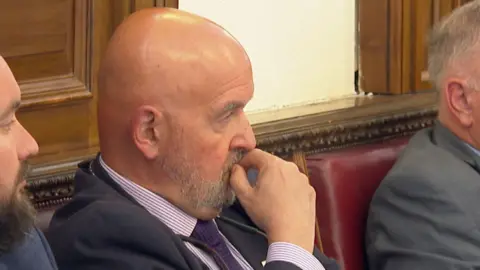
BBCFormer Chief Minister Jonathan Le Tocq has admitted creating thousands of indecent images of children.
He will be sentenced at a later date and his guilty pleas to all 15 counts on Thursday will likely lead to his removal from the States of Guernsey.
He currently remains a member of the States of Guernsey - on a £49,151 a year salary - but there are various ways he could be removed.
Le Tocq is one of 40 members - 38 Guernsey deputies and two Alderney representatives - responsible for the governance of the island, except for defence and foreign policy.
Under article 17 of the Reform Law, the law officers can submit a proposal to the Royal Court to force a deputy out of the States, something that is expected will happen immediately after Le Tocq's sentencing in January.
They can do this if a politician has been sentenced to six or more months in prison, or has not fulfilled the duties of people's deputy for 12 consecutive months - like not attending any States meetings.
Le Tocq's last States meeting was in early July.
The decision to remove the deputy is not made by fellow deputies, but instead by the bailiff - appointed by the monarch as the island's first citizen, a judge and the presiding officer of the States.
What can the States code of conduct do?
All deputies are subject to the States code of conduct, which was administrated by a pan-island comissioner for standards, before she resigned late last month.
Dr Melissa McCullough held the role until 27 November, when she resigned her post following a decision by the States of Guernsey to reject her recommendation to suspend Deputy Gavin St Pier from office.
After being found to have broken the code, deputies can be suspended from the States for a period of time, but that punishment needs to be debated, voted on and accepted by States members.
Deputy Chris Le Tissier was found to have broken the States code of conduct after he admitted to using a social media account to troll people under a pseudonym.
Initially a panel recommended he should be expelled from the States, however, deputies decided he should only be suspended from the States for a year.
How do resignations work for deputies?
Deputies can submit a proposal to resign to the States for a debate.
This proposal can be voted down by deputies, or withdrawn by the presiding officer, who in this case is the bailiff.
In November 2022, Deputy Andy Taylor announced he would resign as vice-president of the Development and Planning Authority.
A month later he u-turned on that decision and States members voted to keep him in the role.
Earlier this year, Deputy Jayne Ozanne resigned as a member of the Committee for Education, Sport and Culture (ESC), before being replaced by Deputy Rob Curgenven.
If Le Tocq is removed it would trigger the first by-election since since the island moved to entirely island-wide elections in 2020.
Some politicians have speculated it could cost about £500,000 for a by-election.
Due to the costs involved there was an attempt to change the rules at the start of this political term, but the move to introduce a rule that there must be at least three vacancies before a poll is held was not supported.
Guernsey's last by-election was in 2016 for a vacancy in the Vale electoral district, following the passing away of Dave Jones - Deputy Neil Inder won his seat at this poll.
A proposal for a by-election has to be submitted to the States and deputies have to approve a date.
Follow BBC Guernsey on X and Facebook and Instagram. Send your story ideas to channel.islands@bbc.co.uk.
