Man had 'cardiac arrest after police e-scooter row'

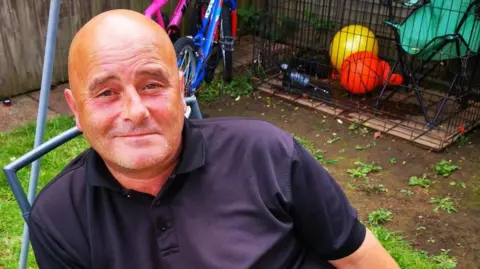 Family photograph
A doting grandfather suffered a cardiac arrest in a police car after an argument with officers who had seized his e-scooter because it was not legal to ride on public roads, an inquest has heard.
Joseph Tidmarsh, 59, had a serious underlying heart condition which meant he "could have dropped dead at any time", a pathologist told Liverpool Coroner's Court.
An emergency medical consultant, Peter Goode, said the police officers who detained Tidmarsh in Liverpool on 22 August 2023 failed to realise the way he was breathing meant he needed immediate chest compressions.
But he said delays in officers administering CPR had only "minimally" contributed to his death.
'Chest compressions'
Jurors were played footage from the police officers' body worn video cameras and a home security system.
They showed Tidmarsh being arrested for a public order offence after the officers stopped him on his e-scooter on Radstock Road in the Fairfield area of the city.
He could be heard shouting and swearing at the officers, at one point shouting that they had "nothing better to do".
Coroner André Rebello told the jury "privately owned e-scooters are legal on private land but can't be used on public roads, cycle lanes or in parks".
He added: "The fact we do have private [rental] schemes where you can ride scooters on roads I suspect probably confuses the public."
The footage showed Tidmarsh becoming unresponsive in the back of the police car, after which the officers laid him down in the road before administering chest compressions.
Goode said: "I would have started (compressions) sooner", after he was asked about the "six to seven minutes" that it took for them to begin after Tidmarsh became unresponsive.
"To my trained eye when Mr Tidmarsh had collapsed in back of the police car he was peri-arrest," he said.
"I could see he was in trouble because he had developed that agonal slow sighing breathing pattern along with becoming unresponsive. That would really concern me."
But he told the court: "You have two police officers who are not trained to do what I do."
He added that in first aid training he "wouldn't normally train people to assess agonal breathing".
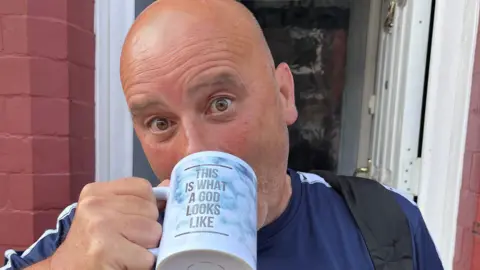 Family photograph
Goode said the officers were "sensible" to start CPR once they could feel no pulse but added "that CPR should have been continued until the paramedics arrived".
He said there was a two-minute point where the officers stopped CPR because "there was this sighing breathing where they thought he'd been responsive to what they were doing and they stopped" until the arrival of paramedics, who told them to recommence CPR.
Under questioning from Tidmarsh's family's lawyer Suzanne Lambert, Goode said the six-minute delay and two-minute pause to CPR "minimally" and "trivially" contributed to Tidmarsh's death.
He said that was because the paramedics arrived with a defibrillator after the window when his heart would normally have responded to being shocked, and when people have cardiac arrests out of hospital "only about 9% survive".
Bravery award
Forensic Home Office pathologist Dr Brian Rodgers said Tidmarsh had "a very diseased heart" which put him "at risk of sudden death".
"Anyone arrested is probably going to be in a stressful situation physiologically and Mr Tidmarsh becoming angry with the officers in the vehicle would have the effect of immediately raising his blood pressure".
He said: "When you've already got damaged vessels in the heart in that kind of stressful situation the heart is basically going to stop."
Tidmarsh died at Royal Liverpool University Hospital the following day, with heart disease given as the cause of death.
The Independent Office for Police Conduct confirmed they had not identified any criminal matters arising from the incident or any breaches of police professional standards.
Tidmarsh's eldest son, Joseph Sheldon, said his father had previously received a police bravery award for intervening when a woman was being attacked.
He told the jury his father "was a friend to most people", and someone who was "forever helping the neighbours with odd jobs".
"Dad was a big kid, he was brilliant with children and his grandkids idolised him and he doted on them.
"He is sorely missed every day, not only by his family and friends, but the wider community."
Listen to the best of BBC Radio Merseyside on Sounds and follow BBC Merseyside on Facebook, X, and Instagram. You can also send story ideas via Whatsapp to 0808 100 2230.
