Odyssey cast shown oldest book copy of Homer's epic
 UoM
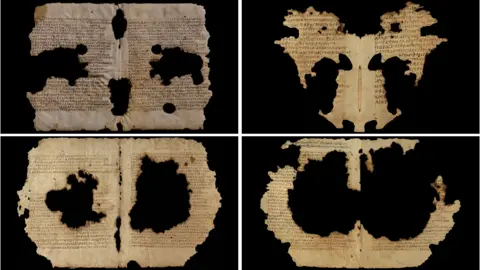
UoMThe stars of Christopher Nolan's new blockbuster The Odyssey were given a rare chance to see a fragment of the oldest surviving book-form copy of Homer's famous epic poem.
Part of a 1,700-year-old copy, kept at Manchester's John Rylands Library was taken by researchers to the film's London premiere.
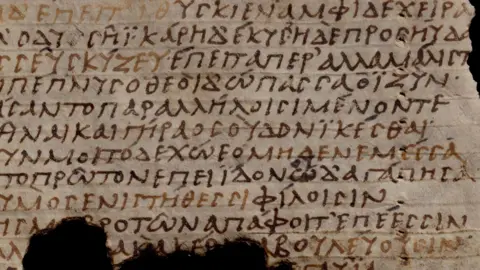
The fragment, written in ancient Greek by what was thought to be an Egyptian scribe and his teacher, is the oldest existing version of the poem arranged into a book.
Prof Christopher Pressler, part of the University of Manchester team tasked with preserving the work, said actor Tom Holland was "super interested" when the cast were shown the text at a press junket in New York.
He said: "There was some mind-blowing moments for people realising that this document is almost 2,000 years-old and of course the poem is 1,000 years older than that."
His colleague Dr Jeremy Penner said the film stars wanted to see where "the names of their characters were in the texts".
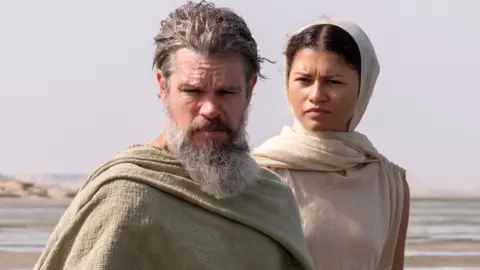
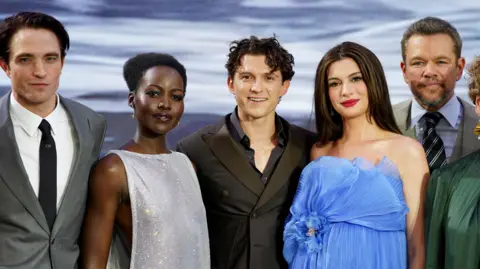
Nolan's film, which was adapted from Homer's epic, stars Matt Damon as Odysseus, with Holland playing his son, Telemachus, and Anne Hathaway as his wife, Penelope.
It also features Robert Pattinson as one of Penelope's suitors, Antinous, and Lupita Nyong'o as both Helen of Troy and her sister Clytemnestra.
Penner, the library's curator of African and Near Eastern Manuscripts, said the actors had been excited to see the text, adding: "Encountering something that old, it's very hard to not have some kind of an emotional reaction."
 Universal Studios
Set in the late Bronze Age, in about the 13th Century BC, The Odyssey tells the story of the hero Odysseus and his quest to return from the Trojan War to his kingdom of Ithaca.
The 24-book poem is attributed to the poet Homer and is thought to have been composed on mainland Greece between 850 and 750 BC.
It has been widely regarded as one of the greatest works of Western literature, has had various translations and is believed to have been translated into English more than 100 times.
The earliest was a Latin translation by Livius Andronicus in the 3rd Century BC. It was translated into English for the first time by playwright George Chapman in the early 17th Century.
 UoM
UoMPressler said Nolan and his family came to see the fragment when it was transported to New York for the US premiere.
"They were very moved I think, and we were able to let Christopher Nolan hold the object, which is entirely protected in its case."
The parchment was transport by the academics while preserved between sheets of glass and placed in a bespoke case.
Though used to travelling with high value items, Pressler said heading through the airport to the US was "a little like being on the set of Mission Impossible".
"We knew what was in this case but nobody else did. But it was a huge responsibility carrying something of global importance through JFK."
 UoM
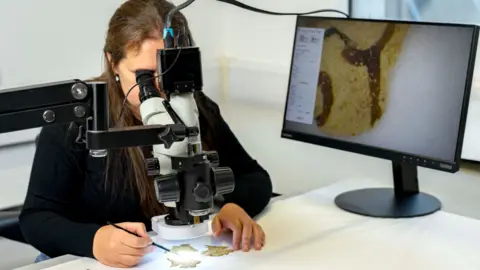
UoMOlder versions of the story exist on clay tablets, but the water-damaged sections of parchment kept at the Manchester library are the most ancient version of the epic in "book" form.
The text formed part of what is known as a codex, where parchment sheets were folded to create pages and marked out to create book numbers to help readers navigate.
A substantial portion of the story has been preserved, including the hero's return to Ithaca.
Penner said the library's copy, known as the Manchester Odyssey, was "exceptionally rare".
"I think that there are probably other institutions that could say 'we've got earlier bits and pieces of the Odyssey', maybe on papyrus, maybe on a roll, [but] this is certainly the earliest example that we have of the Odyssey in book form, which is really interesting because it's a very, very long poem," he said.
"If this was on a roll, it would be either divided into multiple rolls or an exceptionally long roll, which is probably not the case."
The Manchester Odyssey was acquired in Egypt by art collector and Conservative MP Lord Balcarres in 1900.
Parts were found to have rotted away from damp and the sheets were placed between sheets of glass in a bid to preserve them.
They later entered the library's collection and have now been preserved by archivists using modern techniques, including climate control, to protect what remains.
Penner said the work was copied over in Ancient Greek "probably by a student or a somewhat skilful scribe".
In an ancient form of marking homework, a second person's hand can be seen changing mistakes, "going along and correcting them later and adding breath marks", he said.
"There are often times where the original scribe dropped out... or forgot to include two lines and someone came back in later and added them.
"So there's this real sense of trying to get the text correct to get it right," he said.
 PA Media
Penner said the team had analysed the handwriting to "try to get a sense of where this person was socio-historically in the copying of the manuscript".
"At the end of the day, you may not actually be able to say that much about this person, but you do get to know their handwriting, and that's really not that far from starting to get to know someone's personality," he said.
Researchers have been interested in the "juxtaposition between this very ancient object and the new film", Pressler said.
"Christopher Nolan has re-invented Imax to make this film, so it's another leap in technology next a very old leap in technology."
"The story itself is a survivor; One of the fascinating things about holding the object is your holding a story in a story, as the object itself has had an odyssey, from Roman Egypt, to being in the centre of Manchester now as its home."
The university partnered with Universal to bring some of the text to press calls for Nolan's film.
The Manchester Odyssey has now gone on public display in the Collections Gallery at The John Rylands Library.
Listen to the best of BBC Radio Manchester on Sounds and follow BBC Manchester on Facebook, X, and Instagram. You can also send story ideas via Whatsapp to 0808 100 2230.
