Local elections profile: Tower Hamlets

 Reuters
Ahead of the local elections on Thursday 7 May, we have produced short guides to London's 32 boroughs.
Where is it?: The London Borough of Tower Hamlets sits on the north bank of the Thames in east London and is bordered by Newham, Hackney, and the City of London.
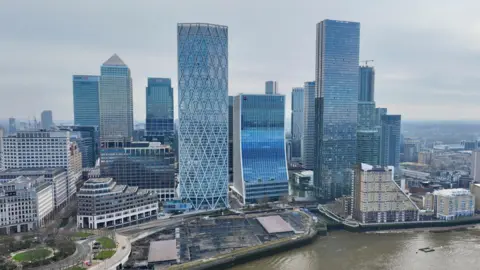
What's it like? It spansthe historic East End of London and a swathe of the regenerated London Docklands.
In recent years, Tower Hamlets has become notable for changing demographics, with high levels of immigration, and the transformation of its skyline as a large number of skyscrapers are built.
Neighbourhoods: Bethnal Green, Bow, Mile End, Whitechapel, Stepney, Wapping, Shadwell, Spitalfields, Limehouse, Poplar, and the Isle of Dogs.
Places of interest Victoria Park, Tower of London, Brick Lane, Spitalfields, Mile End Park, Young V&A, London Museum Docklands, St Katharine Docks, Wilton's Music Hall, Whitechapel Gallery and Queen Elizabeth Olympic Park - part of which falls inside Tower Hamlets.
Pub quiz fact: It is the youngest borough in the UK, with a median age of just 30. It is also the most densely populated borough in England.
Population: 331,886 in 2024, according to 2024 estimate.
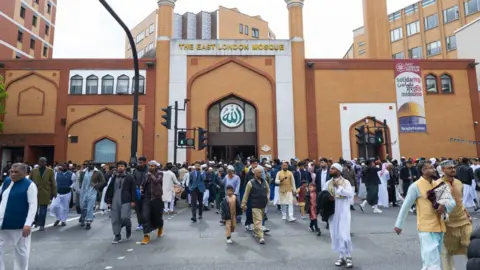
Demographics: According to the 2021 census, 44% as Asian, 39% identify as white, 7% as black, 5% as mixed race and 2% as another ethnic group.
Tower Hamlets is the youngest borough in London and the average age of its residents is 30 - 21.5% of the population are under 20 years old and 45.1% are aged from 20 to 39 years old.
Average property price: According to the Office for National Statistics (ONS), the average residential property price in Tower Hamlets in December 2025 was £464,000.
Average monthly rent: The ONS reported that the average monthly rent in February 2026 in Tower Hamlets was £2,389.
Council tax: Band D council tax in the borough for 2026/27 is £1,837.78.
Transport: The borough is served by nine Tube stations: Aldgate East, Bethnal Green, Bow Road, Bromley-by-Bow, Canary Wharf, Mile End, Stepney Green, Tower Hill and Whitechapel, according to Transport for London.
It has several rail, Overground and DLR stations including Limehouse, Langdon Park, Poplar, Wapping, All Saints and Westferry.
 Getty Images
Local history: The name Tower Hamlets originated in the 16th Century to describe the small settlements, or hamlets, to the east of the Tower of London where inhabitants were required to defend the Tower.
Historically, it is characterised by the East End of London.
By the 18th and 19th centuries, areas such as Whitechapel and Stepney became densely populated, driven by the London docks and textile and manufacturing industries.
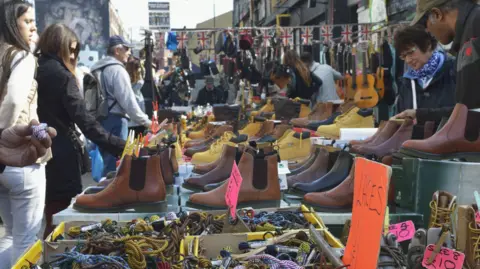
The borough was a centre for successive waves of migrants, including Huguenots, Irish, Jews, and later Bangladeshi communities, especially around Brick Lane.
Heavy bombing during World War Two caused widespread destruction, followed by post-war rebuilding. The London docks began to decline in the late 20th Century, but the Isle of Dogs was regenerated, creating Canary Wharf as a global financial hub.
 Getty Images
What is the electoral history of the borough? Tower Hamlets was a safe borough for the Labour party from its formation in 1965 until 1986 when the Liberal Democrats won control of the council.
Labour won it back in 1994 and faced little opposition to their control until the people of Tower Hamlets voted to introduce a directly elected mayoral system in 2010. The former Labour leader of the council, Lutfur Rahman, who had been barred from standing for Labour, stood as an independent and won the mayoralty in October 2010.
Then at the next set of local elections in 2014 Rahman's supporters, under the new banner of Tower Hamlets First, won 18 seats on the council, plunging Tower Hamlets into no overall control.
But controversy and legal action followed. Rahman was removed as mayor the following year and the election was declared void, after an election commissioner found Rahman guilty of "corrupt and illegal" election practices, which he denied.
Rahman was banned from standing for election again for five years and the mayoral race was re-run, with Labour's John Biggs becoming the elected mayor in 2015. Labour won back control of the council in 2018.
What happened in 2022? Rahman, having served his ban and now leading a new party called Aspire, won the mayoral election and control of the council. Labour was reduced to 19 seats, its lowest number ever on Tower Hamlets council.
Aspire: 24 seats (+24)
Labour: 19 seats (-23)
Conservative: 1 seat (-1)
Greens: 1 seat (+1)
Since the election, two Labour councillors have defected to Aspire, one Labour councillor has become an independent and four Aspire councillors have become independents.
Tower Hamlets has a mayor who will be directly elected by voters on 7 May.
The mayor has significant powers over local services such as housing, including local regeneration schemes and affordable housing targets, planning and waste collection.
The mayor is the political leader of the council and they appoint a cabinet made up of elected councillors who are given specific portfolios such as finance, community safety and children's services.
This is different from the mayor of London, currently Sir Sadiq Khan, who was elected in 2024. The mayor of London has responsibility for police, fire and rescue, Transport for London and strategic matters that affect all 32 London boroughs.
Election expert Tony Travers on what might happen in Tower Hamlets
Professor Tony Travers of the London School of Economics said Tower Hamlets operates in a slightly different political axis to the rest of London politics.
"Mayor Lutfur Rahman and his Aspire party control the borough at the moment and given what we can see about the rest of politics, Labour's weakness, not that much Green activity there, looks as if Aspire will hold on to Tower Hamlets - and Lutfur Rahman must be pretty safe as a bet to win the mayoralty."
Listen to the best of BBC Radio London on Sounds and follow BBC London on Facebook, X and Instagram. Send your story ideas to hello.bbclondon@bbc.co.uk
