Why is the cost of rental property rising so much?

 BBC
BBCOver eight years and five different flats, one thing in Ryan Hoey's life has been constant - his rent keeps going up.
In Belfast, rent prices are growing faster than in any other UK city.
"It doesn't surprise me – I think I've seen it in places I've rented before. Those rises have been quite extortionate, in terms of the rate of increase," he said.
Hoey recently noticed that a south Belfast apartment is charging £800 a month today, compared to the £550 he paid when living there in 2021.
By how much have rents increased?
Rents across Northern Ireland have surged over the past five years in every council area, by an average of 51%.
PropertyPal's Chief Executive Jordan Buchanan shared his sites pricing and listing data over that period.
The average property now costs an extra £335 per month.
"In early 2020, the average rent in Northern Ireland was around £650. At the end of 2025 that's grown to nearly £1,000," Buchanan said.
There are examples across Northern Ireland.
A two-bedroom ground floor apartment, off Belfast's Lisburn Road, was listed for £875 per month in 2021, £1,050 in 2023 and £1,350 last month.
Can renters afford the rises?
Although inflation has seen a general rise in prices and wages, the pace of rent increases has far outstripped that.
People are now spending a larger portion of their income on rent than ever before - from 27.6% in 2020 to about 32.2% now.
"When you look at what has been happening to incomes over that same period, they've increased by around 30%," Buchanan said.
"That gap ultimately means tenants have had to spend more just to service their rental commitments.
"It's not sustainable in terms of the price dynamic."
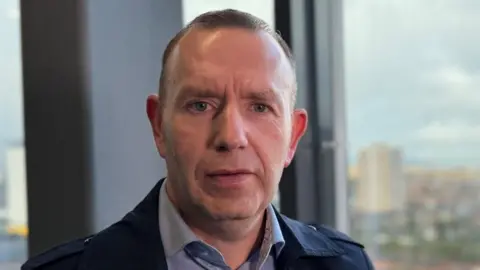
Martin Haran, a professor of Real Estate and Urban Studies at Ulster University, says affordability is a particular challenge for Belfast.
"Over the last 12 months you've seen a 9.6% increase in the Belfast market – it's the most pronounced of any part of Northern Ireland."
Rents in the city are approaching an average cost of £1,100 per month, with more than 40% already higher than this.
When asked if the rental market is broken, he doesn't disagree.
"It needs structural change. It needs reformation. The imbalance between supply and demand is not sustainable."
Why are rents rising so fast?

Buchanan says the answer is simple.
"Supply is the root cause of a lot of these issues, not just in the rental sector this is across the whole housing system," he said.
"Housing supply is at a multi-decade low and that has fed through into the rental sector."
Northern Ireland needs more housing overall, but the rental sector is in particular difficulty. Over the past five years, the number of available rental properties has fallen.
PropertyPal data shows the number of available rental properties is 10% lower than it was pre-Covid.
A lot of that is due to properties being sold instead of rented, but the rise of short-term lets like AirBnB have also played a role.
How many people are competing for each property?
Supply is only part of the story. Although there are fewer properties, demand for rental properties continues to increase.
In the past five years, the average number of enquiries per rental listing across Northern Ireland has gone up by 33%.
A rental property in Derry City and Strabane council area now receives an average of 80 people enquiring, up 79% in five years.
Hoey has seen that change in his own property searches.
"There is a certain pressure put on people looking for a place. Get your application in as quick as possible," he said.
"Particularly if you need to find a place fairly quickly, to just sign up and pay whatever, just to get a roof over your head."
What would help with rising rent?
Buchanan says the solution is more rental properties.
"We need to not just replace that supply, we need to be adding more to that, so that needs more investment into Northern Ireland."
With around 50,000 people on the social housing waiting list, the experts agree more of this type of housing is essential.
Professor Haran says the extent of that waiting list is also pushing more people into private rentals, increasing competition in the sector.
Northern Ireland's first build-to-rent apartments are due to be completed later this year.
The development has had its critics, but it'll add around 750 properties to the market, 630 of those purpose built high end rentals.
Buchanan says its an important addition.
"That's going to be a massive supply injection into what is a seriously constrained sector."
Professor Haran agrees – but with some caveats.
"People will probably roll their eyes a little bit and say that's targeting a certain section of the market but in my opinion, that would probably ease pressures.
"We need that professional build to rent product. Institutional investment, capital coming into Belfast.
"But if you look at Dublin, just because institutional investors come in and provide build to rent it doesn't necessarily always improve affordability. That's where policy and planning frameworks need to be carefully considered to give us a more affordable rental market."
It's a problem without easy answers. With rents still rising, energy bills soaring and general inflation ticking up once more – the news for renters isn't good.
Hoey does his best to see the positives.
"In some senses it is a positive that people are moving to Belfast, it is a place on the up. The supply of housing just isn't keeping pace with that demand."
