US forces attempt to board oil tanker after pursuit across Atlantic

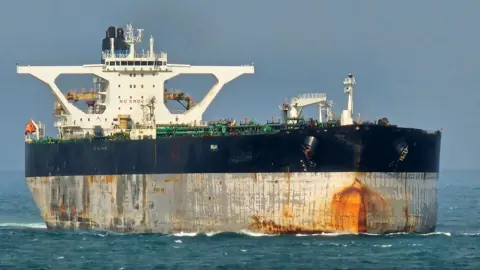 Hakon Rimmereid via Reuters
The US is carrying out an operation to seize a tanker linked to Venezuelan oil, an official tells CBS, the BBC's US news partner.
Previously named Bella 1, its name has been changed to Marinera and it has also reportedly been reflagged from a Guyanese to a Russian vessel.
Russia has reportedly deployed a submarine and other vessels to escort an oil tanker - which is also being pursued by US forces - across the Atlantic.
The ship, currently between Iceland and the British Isles, has been accused of breaking US sanctions and shipping Iranian oil. It has historically transported Venezuelan crude oil but has reported to be empty at the moment.
US President Donald Trump said last month that he was ordering a "blockade" of sanctioned oil tankers entering and leaving Venezuela, a move the government there described as "theft".
Two US officials have confirmed to CBS, the BBC's US news partner, that Russia had sent a submarine and other navy vessels to escort the tanker.
The US Coast Guard tried to board it last month in the Caribbean when it was believed to be heading towards Venezuela. The Coast Guard had a warrant to seize the ship over its alleged breaching of sanctions.
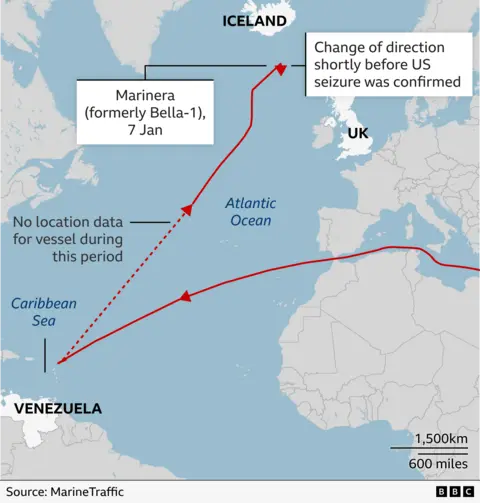
The vessel has since dramatically changed course and its approach to Europe has coincided with the arrival of around 10 US military transport aircraft as well as helicopters.
Russia says it is "monitoring with concern" the situation around the ship.
"At present, our vessel is sailing in the international waters of the North Atlantic under the state flag of the Russian Federation and in full compliance with the norms of international maritime law," its foreign ministry said.
"For reasons unclear to us, the Russian ship is being given increased and clearly disproportionate attention by the US and Nato military, despite its peaceful status," it said.
Two US officials told CBS News earlier on Tuesday that US forces were planning to board the ship and that Washington preferred to seize it rather than sink it.
BBC Verify has been looking at footage released by Russia Today, reportedly taken aboard an oil tanker, which shows a ship in the distance matching the profile of a US Coast Guard Legend-class cutter.
It has also been monitoring the latest reported location of the Marinera. Its location as of Tuesday morning was in the North Atlantic Ocean, about 300km (186 miles) south of Iceland's shoreline, according to AIS location data from ship-tracking platform Marine Traffic.
Previous AIS tracking data suggests it travelled north, past the western coast of the UK, over the past two days.
On Tuesday, the US military's Southern Command posted on social media that it "remains ready to support our US government agency partners in standing against sanctioned vessels and actors transiting through this region".
"Our sea services are vigilant, agile, and postured to track vessels of interest. When the call comes, we will be there."
Before any US military operation were launched from the UK, Washington would be expected to inform its ally.
For now, the UK Ministry of Defence says it will not comment on other nations' military activities.
The US officials quoted by CBS suggested that the US could mount an operation like one conducted last month when its forces seized the Skipper, a large crude oil tanker, flagged to Guyana, that had just left port in Venezuela.
Under international law, vessels flying a country's flag are under the protection of that nation. However, simply changing a ship's name and flag doesn't necessarily change much, Dimitris Ampatzidis, senior risk and compliance analyst at maritime intelligence firm Kpler, told BBC Verify.
"US action is driven by the vessel's underlying identity [IMO number], ownership/control networks, and sanctions history, not by its painted markings or flag claim," he said.
But Michelle Bockmann, a maritime intelligence analyst at Windward, said changing to a Russian registry could "complicate US enforcement efforts".
"Under the UN Convention of the Law of the Sea, there's a provision that allows a stateless vessel to be boarded by authorities. By reflagging to Russia, the vessel is no longer able to be boarded under this provision," she explained.
Bockmann added that she had previously observed vessels changing their flag mid-voyage, but "it's highly unusual and only seen with dark fleet tankers".
The potential stand-off over the oil tanker comes days after the US shocked the world with the arrest of Venezuela's President Nicolás Maduro in Caracas. It bombarded targets in the city during the operation to extricate him and his wife on suspicion of weapon and drug offences.
Since he was seized, BBC Verify has identified three US-sanctioned tankers that have switched to a Russian registry, including the Marinera.
This follows a broader trend.
Since the seizure of the Skipper, BBC Verify has identified 19 US-sanctioned oil tankers that have switched to a Russian registry, with many of them having previously sailed under a false flag.
