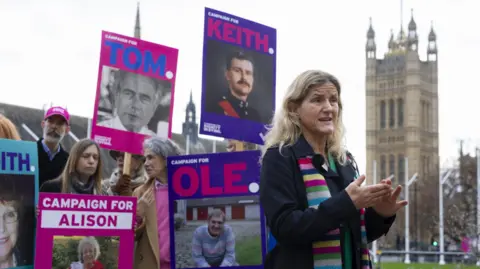
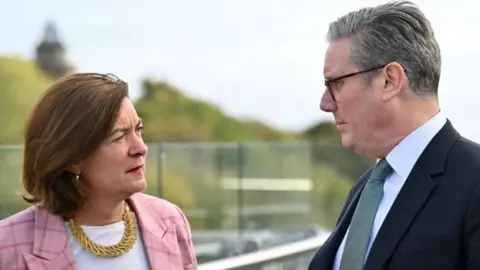
Lying ban for politicians in Wales prompts free speech fears

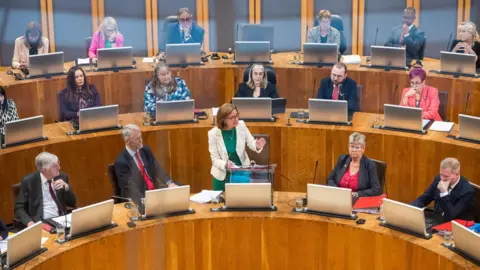 Senedd Cymru/Welsh Parliament
A proposed law to make it illegal for politicians to lie during Welsh elections contains "extraordinary" powers that would limit free speech, Senedd members have warned.
The bill passed its first hurdle in the Senedd on Tuesday but members, including those in Labour, have said it could fail to get enough support without significant changes like defining what a "false or misleading" statement would be.
The Welsh Labour government wants to make it a criminal offence to make false or misleading statements of fact to help an election candidate.
In a statement it said the legislation "sets out to build stronger foundations for Welsh democracy".
Ministers had vowed to take action against lying in politics after a similar proposal almost became law against the Welsh government's wishes last year.
In a debate supporters of the law change urged the Senedd to press on - with Plaid Cymru's Adam Price warning the public would be critical if the provisions were ditched by the Welsh government.
But some MSs from the governing Labour party warned the Senedd was at risk of passing bad law - one said the Senedd was potentially rushing it "to make people feel good".
A Conservative MS said the aim was understandable but that it had been rushed and warned it could "inadvertently restrict legitimate debate".
Supporters of a ban on lying have argued that it could help rebuild trust and confidence in political institutions.
The ban would not be ready for the next election in May and would not come into force until the 2030 election at the earliest - although there is no timescale and one minister has suggested that even that date may not be achievable.
The bill has prompted two damning reports from two cross-party Senedd committees, with the legislation committee warning that the way it was written risked allowing a future government to "seriously hinder full and proper democratic discourse during an election campaign".
It criticised the lack of a consultation, and the fact that it does not define exactly what a "false or misleading" statement is, to who it would apply or how.
Instead, it requires Welsh ministers to create a criminal offence only after the bill becomes law.
A report by a committee set up to scrutinise the bill warned ministers that if they failed to amend the provisions on lying it may not get the support it needs from Senedd politicians.
The committee, led by Labour Senedd member David Rees, said that "a power to limit free speech before or during an election with so few parameters as to the scope of any prohibition would be extraordinary as drafted".
It added it was concerned the Welsh government was asking the Senedd "to give its endorsement to the creation of a new serious criminal offence which is undefined and could have life-defining repercussions".
 PA Media
A majority of the committee felt that if the bill could not be amended in time for the next stage of consideration in the Senedd, the section on false statements should be removed from the proposed law.
The committee also complained about the limited time it had to look at the bill, introduced late into the Senedd term, reducing the opportunity to speak to the public and others.
BBC Wales was told Labour members on the committee and the Conservatives' Sam Rowlands were among those who did not feel the government would have time to make the necessary amendments.
Counsel General Julie James told the Senedd she had "committed to giving further consideration to the feasibility and implications of bringing forward an amendment".
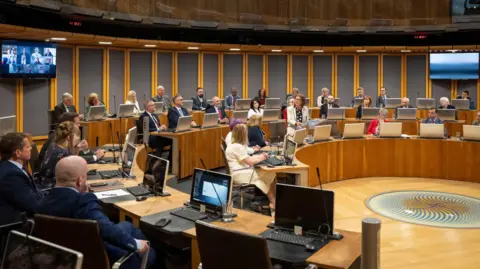 Senedd Cymru
Prof Jeremy Horder, a criminal law expert at London School of Economics, said he feared an "over-broad false statement law" could "have an unduly chilling effect on the speech of conscientious people and media outlets".
In the Senedd on Tuesday supporters of the banning lying in politics spoke up for the government taking action.
The former Plaid Cymru leader Adam Price had, with Labour MS Lee Waters, pushed for the government to take action against lying in politics in 2024.
He said the "public will rightly hold to account" the government if it dropped the plans.
"There will be an opportunity for the later stages of this bill to improve it, not remove the commitment," he said.
But deputy presiding officer and Labour MS David Rees told Price: "It is important that the Senedd gets the law right, and there's good law.
"That's important. If we rush this and don't get it right we'll be held accountable for that as well."
Alun Davies, Labour MS for Blaenau Gwent, said: "What we don't need is bad law passed in a poor way, rushed through in order to make people feel good about themselves whilst not addressing the fundamental issues that this society has to face."
Liberal Democrat Jane Dodds said she recognised the "serious concerns" raised by the committee, but urged the Senedd to amend the bill and supported it coming into effect at the next election in May.
"Lying flourishes in politics because we can get away with it, because we face no real consequences," she said.
Conservative MS Sam Rowlands said it was a "real shame that this has been rushed", accusing the government of bringing the law forward "at the very last moment".
That was disputed by Lee Waters, who said it had been discussed by the Senedd "for some two years".
Calling for the provision on lying to be scrapped, he added: "This aim of protecting voters from deliberate misinformation is absolutely understandable, but these measures could inadvertently restrict legitimate debate and political discussion."
With broad support across the Senedd for the other measures in the bill, including proposed recall polls to remove misbehaving MSs, the bill passed its first stage in the Senedd without a vote.
It will return to a committee for amendments in February. The Senedd will also need to agree a financial motion to allow money to be spent on the law first, however. It was meant to be agreed on Tuesday but was pulled for more work to be done.
A Welsh government spokesperson said the legislation "sets out to build stronger foundations for Welsh democracy".
"Having carefully considered the committees' reports we have accepted in principle, or noted the significant majority of the recommendations ahead of the general principles debate," they said.
The draft law does not legislate for a ban on Senedd politicians lying more generally, after a committee recommended that the existing regime of investigations by a parliamentary standards commissioner be strengthened instead.
It is already illegal to make a false statement concerning the personal character or conduct of a candidate during an election.
A Reform UK Wales spokesperson said: "People in Wales can see through this attempt to stifle free speech."
They added: "Banning speech does not strengthen democracy, it threatens democracy."