Labour booked £25,000 of Airbnbs in historic by-election loss

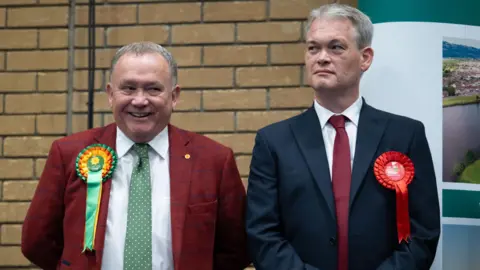 Getty Images
Welsh Labour booked £25,000 worth of Airbnbs during its failed Caerphilly by-election campaign, documents seen by BBC Wales have revealed.
Receipts showing the party arranged staff accommodation for 22 guests in six properties dotted around south Wales have been disclosed in Labour election campaign returns.
Both Labour and Reform spent more than double Plaid Cymru's campaign costs, whose candidate Lindsay Whittle won the election.
Former Labour minister Mick Antoniw said his party had "clearly failed to engage" with a "Welsh message" at the vote.
Labour said: "All necessary declarations have been made transparently and in full accordance with the rules."
First Minister Eluned Morgan's Labour spent £98,447.19 trying to avoid the party's first parliamentary defeat in the seat for more than 100 years, only to come in third place.
Labour spent £26.51 per vote if their total was broken down by the 3,713 votes for the party's candidate Richard Tunnicliffe.
Plaid's candidate Whittle was victorious after his party spent £46,933, while Reform UK, which came second, spent £96,125.
Labour provided receipts for six Airbnb bookings for 22 people stretching from September into October last year, worth a total of £25,315.
The properties were located in Trefforest, Blaenau Gwent, Cardiff, Hirwaun, and two in Newport.
Welsh Labour was asked if the Airbnb guests were staff from the UK party but it did not answer the question.
The value of the bookings differed from the figure written in the return, however, which declared a much smaller sum of £3,321 for "staff accommodation" from Airbnb.
When BBC Wales asked Labour to explain the difference, it was told it was common practice for candidates and parties to divide and share spending where some elements of an invoice count as regulated expenditure and others do not.
It was not explained what parts of the invoice were not regulated expenditure - spending which has to be declared.
Former Welsh government counsel general Mick Antoniw, a Labour MS, said the figures showed "the message is more important than the quantity".
"Campaigns must be local and Welsh and we failed," he said.
 Getty Images
Both Reform and Labour came close to the legal spending limit of £100,000.
Before its defeat, Labour had won every domestic parliamentary election in the seat since the early 20th century.
The Senedd by-election on 23 October was triggered by the death of Labour MS Hefin David.
Political parties are required by law to file returns detailing what they spend during by-election campaigns, which can be viewed by the public.
Labour's return lists advertising spend worth £40,470 and unsolicited material like leaflets to electors worth £45,840.
The party paid for £31,295 of advertising on Meta and Google.
Reform's return was divided into £55,239 for unsolicited material to electors, £16,500 for staffing and accommodation, £16,003 for advertising, admin costs of £6,744, and £1,637 for transport.
Individual entries in the return show Reform spent £49,854 on leaflets and letters, including one entry for a letter that was worth £17,084.
Reform's unsolicited material category included £4,794 in spending on Facebook.
Plaid Cymru spent £46,933 according to its return, including £21,649 on unsolicited material to electors, £12,794 on advertising, £6,710 on agent and staff costs and £5,208 on accommodation and administration.
A Plaid spokesperson said it was "proud of the positive, people-powered campaign we ran, with volunteers knocking doors and delivering leaflets in every corner of Caerphilly".
Reform was also asked to comment.
Analysis
by Gareth Lewis, BBC Wales political editor
There is nothing cloak and dagger about digging out these figures.
My colleague David Deans and I booked an appointment to visit the electoral services department at Caerphilly council and asked to see the election returns.
It's democracy in action, if you like.
On a wet Monday morning in Bargoed, cups of tea in hand, we were presented with bundles of documents and got down to reading through them.
It is hard to extrapolate too much from one by-election as there are many factors to consider, but one message could be that how political parties spend their money could be more important than the amount they spend.
How much can you spend in the next Senedd election?
The rules for a by-election are very different to what parties are allowed to spend in a Wales-wide Senedd election.
For this election, each party that tables at least six candidates in every one of Wales' 16 constituencies will be able to spend a total of £1.12m.
That is almost double the maximum of £600,000 in the election five years ago.
In May 96 Senedd members will be elected, up from the 60 that were elected in 2021.
Politicians will be elected from party lists, with six candidates picked per constituency through a system that will elect them according to the proportion of the vote they get.
