'Middle of the night' gritters keep city moving

 BBC
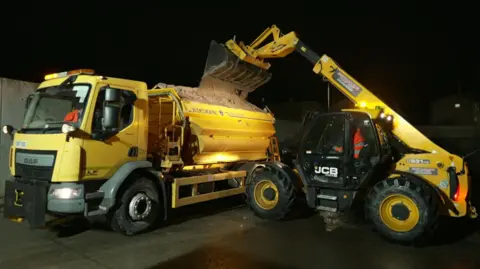
BBCDuring winter's cold snaps, gritters work through the night spreading rock salt that helps keep traffic moving. Hull City Council's Stockholm Road depot is home to six of the vehicles and stocked with up to 4,000 tonnes of grit.
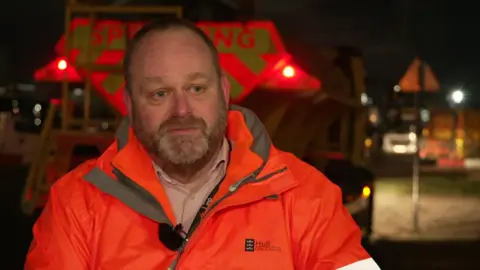
"The residents of Hull don't see a lot of what we do because it's in the middle of the night," site manager Paul Fincham explains. "It's dark... we're out doing things."
He says he enjoys his job, which he describes as "different and challenging".
Fincham monitors the level of grit at the depot and makes sure the fleet of gritters are in good condition and ready to be sent out.
Weather centres in Hull and the East Riding of Yorkshire predict the forecast which determines when the city's gritters are deployed.
Rock salt is effective at temperatures down to -8 to 10C (14 - 18F). Below that, salted roads will freeze, I am told.
During the winter months, Fincham and his team keep an hourly watch of the temperature.
"It's a difficult decision some days," he tells me.
Hull's roads have already been gritted 14 times this winter. The team has seen much worse.
When the cold spell known as the Beast from the East gripped the UK in 2018, the team of about 20 staff was put to the test.
"We had a constant round-the-clock team here. I slept here one night," Fincham says.
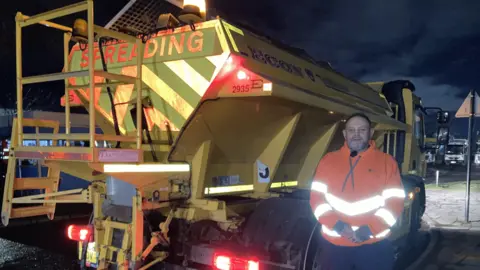
Team member James Aramayo has spread thousands of tonnes of grit on Hull's roads over the past three years.
Route 5 across North Bransholme, Kingswood, Orchard Park and Endike Lane, is his regular route. The 50mile (80km) trip takes two hours to complete.
Often, the vehicles head out after rush hour, but much depends on the forecast, I am told.
"We try to choose the times we're going out to avoid the traffic, but obviously we can't control the weather and we do get stuck in traffic and it can double our time doing our run," Aramayo says.
The majority of drivers and cyclists understand, but for others there can be frustration.
Aramayo says: "Because of the grit spinning off the road and hitting the vehicles, people try overtaking - especially cyclists.
"But we just have to do our job. People know what we're doing and they have to just work around us as best they can."
'Rain means go again'
His vehicle includes a monitor that allows him to adjust the spread of grit according to the road width, while a gauge shows him exactly how much grit is left.
There have been times when conditions have been so bad that Aramayo has had to make up to three, two-hour runs in a day.
Rainfall is the team's nemesis, it seems.
"If it rains and it washes the grit away, we go back and load up and go again," Aramayo says.
At the end of each run all the vehicles get a wash down and are emptied of unused grit ready for the next shift.
Aramayo says he is proud to be part of the team and the work they do to keep the bus networks, emergency services, sheltered housing and medical centres free of snow and ice during the winter's colder nights.
"It's job satisfaction knowing that we're keeping the public and emergency safe and keeping the city running smooth," he adds.
Listen to highlights fromHull and East Yorkshire on BBC Sounds, watch the latest episode of Look Northor tell us about a story you think we should be coveringhere.
Download the BBC News app from the App Store for iPhone and iPad or Google Play for Android devices
