Are 'love locks' a threat to historic bridges?

 Chris Doidge/BBC
About two million people in England have attached a love lock to a bridge - according to a survey from Sheffield Hallam University - and some will even be doing it this Valentine's Day.
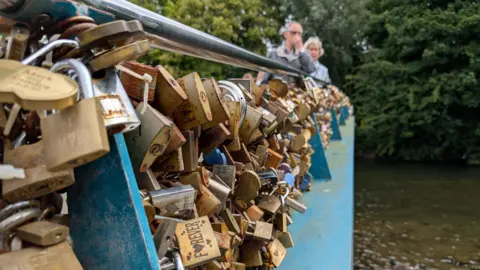
Love locks are a padlock, often engraved with a couple's names or initials, which is then locked on to a bridge or gate as a signal of commitment.
In the last 20 years they have appeared across Yorkshire, from Otley Bridge near Leeds to a railway bridge in Rother Valley Country Park and Scarborough Bridge in York.
Dr David Clarke, associate professor at Sheffield Hallam University's Centre for Contemporary Legend, says the love lock tradition started with an Italian novel.
"It's sort of spread, as folklore does, right across Europe, so it's going on everywhere now, and particularly in England it seems to be very popular," he says.
"A lot of folkloric traditions such as love locks are actually only 10, 15, 20 years old. There's new folklore being invented all the time, which is why we wanted to run this survey to try and capture what is really going on."
The National Folklore Survey for England asked 1,800 people about a range of topics including romance traditions.
Results showed 4.9% of the population has placed a love lock and 49% mark Valentine's Day, with those aged 16-34 most likely to celebrate.
While romantic, the practice has caused council's some pretty big headaches - with some local authorities asking couples to avoid the practice because of potential damage to infrastructure.
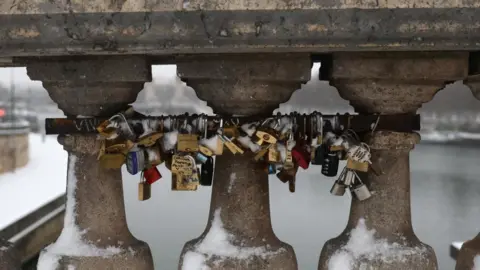
In Paris in 2014, part of the parapet of the Pont Des Arts bridge collapsed under the weight of the locks that had been attached.
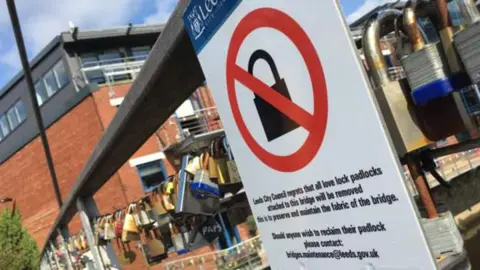
In Leeds in 2016, the love locks were removed from Centenary Bridge after the council claimed they caused "structural problems".
"Although we understand that people have attached them to the bridge as a sign of affection, the locks can cause corrosion to metalwork and structural problems for bridges," a spokesperson said at the time.
In May 2025, when Leeds City Council was working on Otley Bridge it removed a number of love locks, asking the public to come and collect them.
Clarke says councils across the globe have been affected by the tradition.
"Not far from where I live in Bakewell in Derbyshire, there was a bridge that had so many of these padlocks on it that the local authority has had to remove them because the bridge was in danger under the weight of the metal," he says.
"Folklore is a great thing, but also it needs to have measures in place to deal with the popularity of some of these customs.
"Because if a bridge is in danger of collapse because it's got so many love locks on it, however great a tradition it is in bringing people together and bringing joy, people need to be aware that they can also damage places that are historically important from a heritage point of view."
 Reuters
The survey also asked participants about lucky objects, and found people are most likely to carry pebbles, crystals and shells.
"The second most common type of lucky object was one associated with a loved one. So people carry photos of grandparents, children, husbands and wives for luck," says Clarke.
But the practices are not just followed by young romantics and old wives, he says.
"One of the responses we got was a soldier who had escaped death by inches. He must have been shot in Afghanistan or Iraq and he'd actually got the bullet that nearly killed him and he carries it around with him for luck.
"I was reading only the other day about the rocket the Americans are sending to the moon. And there was a whole list of all the things the four astronauts are taking with them.
"Virtually all of them are taking exactly that - photographs of their children, wives, husbands, and lucky objects.
"One of them is taking pendants with half-moons on that have been given to him by his two children and wife. So even astronauts do these kinds of things."
