'Tigers and flies': Millions of officials later, why is Xi's corruption purge still going?

 Getty Images
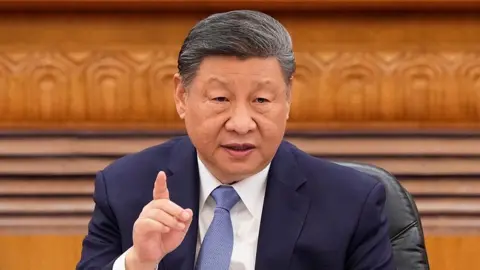
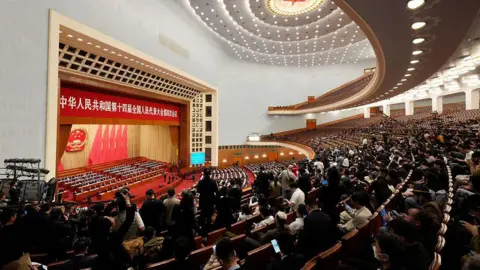
For one whole week, thousands of delegates filed into the cavernous Great Hall of the People in Beijing to attend one of the most important events on the Chinese political calendar.
With Xi Jinping firmly at the helm, the National People's Congress, which concluded on Thursday, is an annual statement on where China is headed - and how it plans to get there.
But absent from the meticulously choreographed proceedings were some of Xi's formerly trusted confidants, and other high-ranking officials - about 100 delegates were not present for the opening session, all swept up in a relentless wave of recent dismissals.
The empty seats tell a different story to the steady, unified governance that Xi and the Chinese Communist Party seek to project.
They are the starkest evidence of Xi's sweeping anti-corruption campaign which began when he was appointed general secretary of the party in 2012.
More than a decade on, it shows no signs of slowing down. Why?
'It's corruption, pure and simple'
Back in 2012, corruption really was a problem in China.
The Communist Party is a massive institution, with more than 100 million members and millions of officials. "So it's not surprising there are people who will make mistakes or who are corrupt," says Professor Kerry Brown of King's College London.
Still, corruption had become endemic. Officials are not paid very well, Brown explains, and the system is run by "a small political elite with an enormous amount of power".
Xi's predecessor Hu Jintao called corruption a corrosive challenge that would "cost the party the support of the people". So Xi made it his mission to stamp it out.
 Getty Images
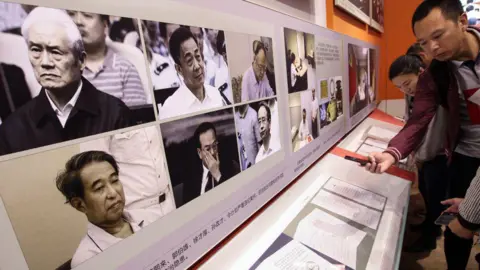
What followed were a slew of shocking arrests. In 2012-2013, an embezzlement and murder scandal brought down Bo Xilai, a rising star in the party who was tipped to be Xi's main rival for the top job. In 2014 the man who once headed China's vast security apparatus was arrested, and two years later, Hu's top aide was jailed for life for corruption.
From government ministers to village chiefs, no-one has been spared in Xi's campaign against "tigers and flies" - that is, both high-ranking elites and grassroots officials. The result: millions of officials have been disciplined, sacked and even jailed in the last 14 years.
"The surprise is not that people are taking inducements or backhanders, the surprise is that there's people that don't do that… So I think some of these people have been removed because of corruption, pure and simple," Brown said.
In 2025 alone, China's top anti-graft body reported that nearly one million individuals were disciplined. In January this year, 10 "tigers" were taken down, according to state media.
Brown, however, is cautious about the numbers: "To be disciplined covers anything from just being told off, to getting a nasty letter saying don't do this again, right up to getting put in prison and expelled from the party."
But every reprimand points to how central this anti-corruption drive has become for Xi. "From the moment he came to power, he has tried to discipline the party," Brown says.
 Getty Images
And he never stopped, partly because graft is hard to root out from the system. Even after the first round of purges in the military more than a decade ago, "ranks and promotions were routinely up for sale, and bribery was rampant", according to Berlin-based think tank the Mercator Institute for China Studies (Merics).
"It's very hard to deal with [corruption] when you don't have the checks and balances and accountability that you would need to be able to manage the party properly," Brown says. "It has no real external source to kind of keep it in order."
Of course that's not how the party sees it. According to state media, "the only reason that new cases keep emerging is because 'the more you dig, the deeper you get'", says Helena Legarda, a researcher at Merics.
But this is not the full story of the purges, which have been driven by a leader exerting ever more control over the party and the country.
Power, loyalty and legacy
"Xi's anti-corruption campaign has always been about both corruption and politics," says Neil Thomas, from the Asia Society Policy Institute.
"It is an effort to make the party a more effective governing machine and a cudgel to remove political enemies."
Brown describes it as a "kind of corporate clean-out, a management tool - it keeps people on their toes".
Under Xi, China has become a global economic force, which has also boosted its geopolitical clout. Billions are being poured into advanced chips, artificial intelligence and renewables - key sectors that will decide Beijing's position in the world and the outcome of its race with the US.
Some have noted a spike in investigations into sectors just as they benefit from generous government funding - such as tech or military contracts. Because these are the very areas that Xi, and the top leadership, have designated as critical, corruption linked to them is seen as particularly egregious.
"I think the idea from the leadership is that if the party isn't disciplined and if it isn't on message and if it isn't unified, then they're going to go the way of almost all other political parties in the world and be divided and challenged and that's a risk they can't take," Brown says.
For Xi, observers argue, corruption has become a catch-all term that encompasses not just graft, from small-time favours to huge bribes, but much more - ideological impurity, a lack of commitment to China's ambitions and, crucially, disloyalty.
They say it triggers one of his big fears: an out-of-control party would prove disastrous for China, like it did for another major communist power, the erstwhile Soviet Union, whose fall he has often spoken about. The possibility of any such decline on his watch would threaten his power - and his legacy.
 Getty Images
In January, Xi told officials they would be left "with no place to hide" because "the fight against corruption is a struggle that the party cannot afford to lose, and must never lose".
If it sounds existential, it is because it is. "It's not like losing an election, they lose everything," Brown says. "So I think this is the sign of a party which is very much aware of its vulnerabilities."
Put simply, the pressure is on. As observers see it, Xi has been in power a long time and his historic third term ends next year.
While China's global influence grows and the competition with the US heats up, Xi is also battling a slowing economy and discontent among youth. So the emphasis on unity, patriotism and the need to fight corruption for a "national rejuvenation" is not mere rhetoric.
It is also a constant attempt to stay in control - and keep any threats or challenges at bay.
Survival
Nowhere is that clearer than in the military.
In 2012, Xi assumed the role of chairman of the Central Military Commission, the top-decision making body for the armed forces. In the years since he has reshaped the structure of the People's Liberation Army (PLA), bringing it under his direct control, often with the help of purges, observers say.
"Purges have increased across the board, but the PLA is a massive outlier. Most of its senior leadership has been decimated by disciplinary actions during Xi's third term," Thomas says, noting that they stemmed from "genuine graft but expanded to include perceived political disloyalty".
About 52% of PLA leadership positions have been impacted, according to the Center for Strategic and International Studies.
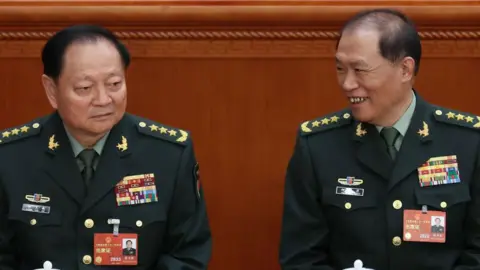
The biggest recent swoop was in late 2025, when nine top generals , including He Weidong and Miao Hua, who were both on the CMC, were accused of crimes involving an "exceptionally large amount of money [and] extremely serious in nature".
Then in January, China announced the removal of Generals Liu Zhenli and Zhang Youxia for "serious violations of discipline and law", according to state media. Zhang, one of Xi's closest military allies, was the vice-chairman of the CMC.
This powerful body, which Xi leads, is now down from seven to two men, including Xi.
"Official narratives after the purge of Zhang and Liu make clear that their dismissals were political in nature and based on a [perceived or real] lack of loyalty to Xi and his goals," says Legarda.
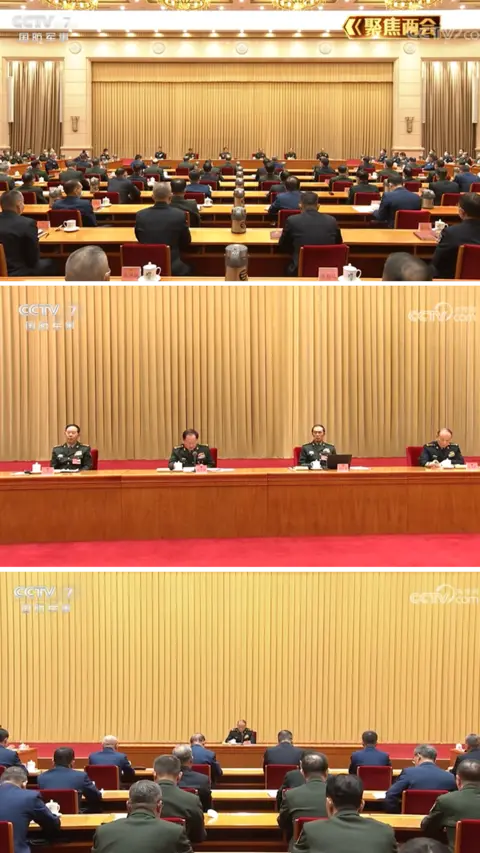 CCTV
CCTVThe emphasis on loyalty suggests that personal survival is a factor.
"Xi knows well that controlling the PLA is crucial to his long-term political future," notes analyst Brian Hart in a CSIS report.
He points out that former leader Jiang Zemin retained his chairmanship of the CMC for two years after stepping down, undermining his successor's power. Xi wants to avoid that so he can have "lasting influence with the PLA," Hart writes.
Purges are not new to the opaque yet cut-throat politics of the Chinese Communist Party. Mao Zedong, the founder of communist China, regularly purged his top lieutenants, sometimes more than once, after bringing them back. Xi's father himself was a target.
In Xi's case, corruption charges have become a form of "political contestation that he has developed into the main basis of his power," Prof Frank Pieke of Leiden University says.
The dismissals don't appear to be over because Premier Li Qiang said at the congress last week that Beijing would "continue its political rectification of the military".
Xi's circle of trusted followers is narrowing ever more to exclude the very people he relied on to consolidate his power, Pieke says, but he expects this to "continue to play out until there are hardly any leaders left that aren't complete Xi products".
As Thomas puts it: "The more powerful Xi becomes, the more he purges."
Additional reporting by BBC Monitoring's Ian Tang
