No quick fix for London's potholes, report warns

 BBC
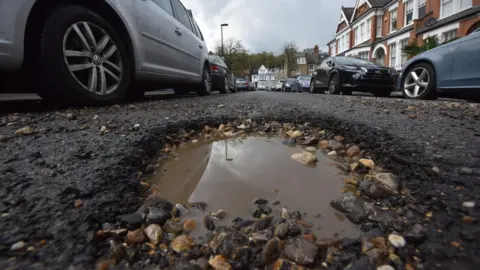
BBCThere is no quick fix to the condition of London's roads, despite a reported increase in funding, this year's Annual Local Authority Road Maintenance (ALARM) survey report has concluded.
Investment in highways maintenance from boroughs' own sources, and an allocation from the Department for Transport (DfT), has resulted in some marginal early improvements.
However, the cost related to the backlog of carriageway repairs in the capital has increased to £1.22bn.
Nearly half of the network is reported to be in good structural condition, but 20% of it - equivalent to over 1,900 miles - is reported to have less than five years' structural life remaining.
 Getty Images
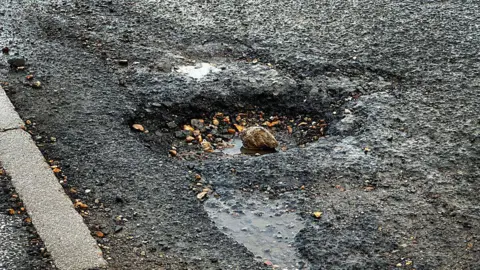
Dr Ian Lancaster, director of the Asphalt Industry Alliance, described the state of the roads as "pretty horrific".
"I only need to step out of the door, get into my car, and then I'm met with potholes everywhere. It's frightening, and it's affecting the way that people drive. I see people swerving to avoid potholes. I see them slowing down.
"We see people getting injured. We see damage to vehicles. We have to recognise that the local road network is absolutely critical for mobility.
"Every journey starts on a local road. If we allow this to carry on, people are not going to be able to get out to hospital appointments, doctor's appointments, down to the supermarket.
"And it has such a terrible effect on the local economy."
A DfT spokesman said the report "rightly highlights the need to improve our roads" and pointed out that the government had raised the funding level to help councils "fix the pothole plague".
"We're already seeing progress, with 15% more pothole-prevention works carried out in 2025 compared to 2024," he added.
Highway maintenance funding sources in London
The UK government withdrew annual funding to Transport for London (TfL) in 2018. Since then, London boroughs have not received any funding support for the maintenance of principal routes. They also do not currently receive any funding for highway maintenance from the Ulez scheme.
However, there are several competitive bid-for grants available from TfL, including Local Implementation Plans and the Liveable Neighbourhoods scheme, which can be allocated to road maintenance.
In 2025-26 London boroughs received some direct funding from the incentive element of DfT's Highways Maintenance Block, providing they demonstrated they met certain best-practice criteria.
Local road maintenance is now predominantly funded by London borough's own sources. These include council reserves, a share of business rates, borrowing and fines, as well as developer contributions such as Section 106 agreements and the Community Infrastructure Levy.
The additional amount London boroughs said they would need is likely to be compounded by the impact of one of the wettest winters on record, the report found.
This year's survey received responses from 81% of London boroughs, and findings included:
- An extra £9.7m per borough was needed last year to maintain their network to their own target conditions and prevent further decline
- £1.22bn is now required as a one-off for local authorities in the capital to bring the network up to their "ideal" conditions
- More than half of local roads in London are now reported to have less than 15 years' structural life remaining – almost 5,000 miles of the network
- 82,226 potholes were filled over the last year at a cost of £6.5m
Listen to the best of BBC Radio London on Sounds and follow BBC London on Facebook, X and Instagram. Send your story ideas to hello.bbclondon@bbc.co.uk
