'Dementia has not stopped me speaking other languages'

 BBC
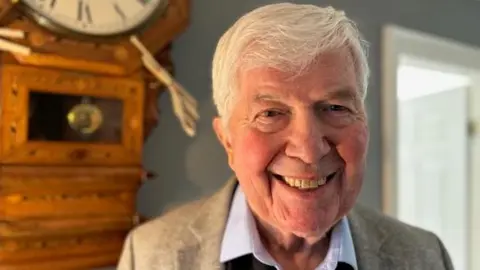
BBCNigel Thomas was diagnosed with dementia three years ago but can still speak French, German and Italian and says he likes the challenge of translating Romanian.
The 79-year-old, who lives in a suburban village in South Tyneside, has a form of the disease known as dementia with Lewy bodies in the UK (DLB). It is the same form that actor Robin Williams had, without realising it, when he died in 2024, and is often not properly diagnosed until after death.
Thomas says "half the time people don't know I've got anything wrong with me". He wants to raise awareness of the condition, which can come with a large variety of symptoms.
Researchers at Newcastle University, who are supporting him, say DLB is "under-diagnosed and under-recognised".
It was Thomas' wife, Heather, who first noticed changes in his behaviour.
"Nigel was becoming obsessive about his wallet, his spectacles and his phone," she says.
"He needed to have them on him, and he would be desperate, even going to bed, if he didn't have these three things."
She also noticed he was walking more slowly.
"People were saying to me 'Heather you're exaggerating, there's nothing the matter'," she says. "But I was saying, 'I know there is'."
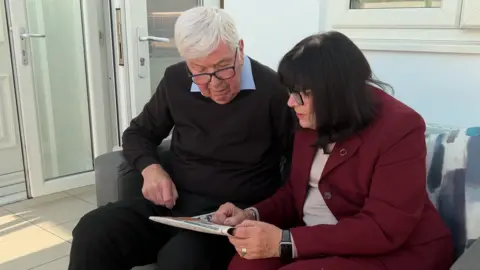
Thomas, from Cleadon Village, has mobility issues which vary from day to day and is slower than he used to be. He has some memory loss, difficulties with comprehension, and already had long-term issues with sleep.
Because of the unpredictability of his symptoms he cannot drive.
There are multiple types of dementia that can develop later in life. DLB shares many symptoms with conditions like Alzheimer's, though it affects memory less.
Patients with DLB often report visual hallucinations, which can be very traumatic for patients and their families, though this is not something Thomas currently experiences.
DLB symptoms can also be similar to Parkinson's disease, so patients may have difficulty with their movement and experience tremors.
Urinary conditions, constipation and sleep issues are also typical.
The couple say it took a long time to get an official diagnosis through the NHS so they resorted to asking for help from academic sleep experts they knew of.
 Supplied
Since Thomas' diagnosis, the couple's lives have changed significantly.
"You tend to surrender your independence," he said.
"Before I could do everything myself, and had pride in doing everything myself.
"Heather gives me things to do so that I'm not just sitting there doing nothing but, if it wasn't for her, I'd have a job working out what to do."
But while Thomas has lost the ability to drive and carry out some simple tasks, he remains intellectually sharp.
"I was a modern languages lecturer in French and German and I can speak Italian as well," he says.
"I tell people Romanian's a pretty easy language to work out and people say - well, how exotic."
Thomas is being supported by researchers at Newcastle University which, in November, won a Queen Elizabeth Prize for Higher and Further Education for its work on DLB.
The team is led by professor of translational dementia research John-Paul Taylor, who has has been studying the condition for 30 years.
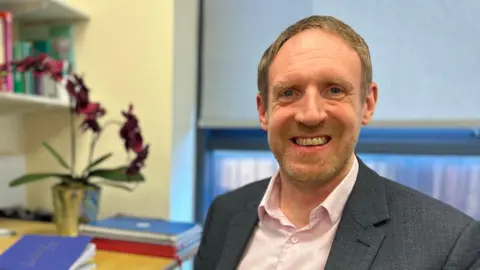
An estimated 130,000 people in the UK currently have diagnosis of DLB, approximately one in five of those who get dementia, Taylor says.
"I think it's under-diagnosed and it's often misdiagnosed," he says.
"Overall, it's not really recognised."
Taylor's team provides ongoing care for Thomas, trying a range of medications for conditions such as Parkinson's and Alzheimer's and monitoring what works.
Taylor says the symptoms of DLB can be very different for each patient so treatment "needs to be really unique to that person".
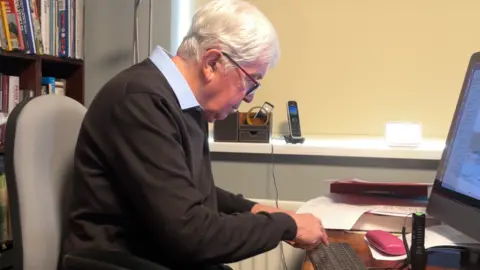
The Thomases are grateful for the university team's research and say meeting Taylor was "key" .
"Suddenly there was someone who had all the answers," Thomas says. "He's been an absolute lifesaver for me."
The couple say the treatments suggested by the university mean Thomas can still live at home, which they believe is helpful, and allow him to carry on doing what he wants for longer.
"It's not a cure," Heather Thomas says. "But at least its giving some quality of life and we're not in the position where he'd have to have care or even go into residential care."
She says anyone who suspects they may have dementia should push for answers.
"Do persevere to get the correct diagnosis," she says. "Because it isn't Alzheimer's, it isn't any other kind of dementia, it's much more specific.
"Only when you know exactly do you get the appropriate treatment."
