'My romance was a Cinderella story - but the abuse began immediately'

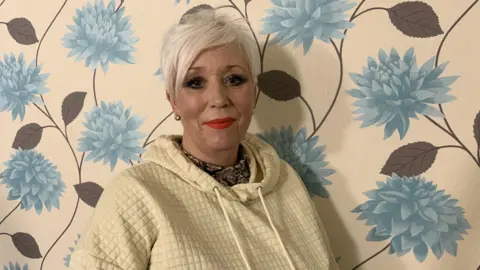 BBC/Lucy Ashton
While the festive season is supposedly one of goodwill to all, statistics show that domestic abuse cases spike. Reporter Lucy Ashton spoke to one woman who now helps others after violence left her fearing for her own life.
"He swept me off my feet. To the outside world, this was the Cinderella story. I was a rescued princess but the abuse started from day one," recalls Charmian Owston.
She sits by a children's Advent calendar and pile of Christmas gift bags in a women's refuge, the festivities jarring with her story about coercive control and abuse.
Sheffield Women's Aid, which is marking its 50th year, started out in the mid 70s as little more than a squat in Burngreave for women fleeing violence and has grown to become an organisation offering 36 flats and 10 safe houses.
Charmian spent 15 months at the refuge and bluntly admits: "They saved my life."
If you look at the 53-year-old's social media, it shows her making comical reels in brightly-coloured lipstick; she's cheerful, confidently spoken and her outfit and manner brighten up the anonymous room.
She says she is comfortable being identified as her ex-partner died a few weeks before he was due to stand trial on charges of assault, stalking, harassment and resisting arrest in 2022.
Charmian was in her late 30s when they met online and became friends. When his marriage broke down, they began a relationship but she says she was groomed from day one.
"I was quite vulnerable at the time, I was in early recovery from addiction so I was perfect for the taking.
"At first he was very proper, very polite, it appeared he was living an honest decent life, he had a good job and had been married for a long time.
"There's something called love bombing and he swept me off my feet.
"He would buy me things and shower me with attention. Our relationship was quite public on social media and to the outside world, this was the Cinderella story."
Charmian says it wasn't until she had fled the situation and looked back that she realised the control had started from day one.
'Ripe for the picking'
"I lived in Scotland and his friend drove him up with all his belongings," she explains.
"We were walking on a beach and I hung back so he could spend some time with his friend.
"It didn't come back to me until a couple of years ago that he had verbally abused me in front of his friend in the house that night, the day that he moved in."
She says she was fragile at the time and, although she knew what was going on, felt powerless to do anything.
"I didn't know what to look for in red flags and I hadn't had many proper, healthy relationships in my life, so I was ripe for the picking," she says.
"He used to gaslight me and would tell me things were happening when they weren't, or he would make things happen, then tell me they didn't happen.
"It wasn't until after I left and started unravelling all this that I saw the absolute seriousness and the alarming rate at which he was doing this."
- If you are affected by any of the issues in this story, you can access support and information via BBC Action Line
The abuse escalated when her ex started bringing alcohol and drugs into the house despite knowing Charmian was a recovering addict. His own mental health also deteriorated very quickly.
"It started unravelling quite quickly. He got me to go to the doctor all the time, suggesting that I was mentally unwell.
"That happens a lot with abusive relationships, these perpetrators are very clever at making suggestions but it's very dark, it's very serious and it's very intricate," she remembers.
"He was becoming really quite aggressive and the tipping point was he threatened to commit suicide one night so I phoned the police and that was the catalyst that started my escape route."
 Roos Koole/Getty Images
A multi-agency task force which helps people at very serious risk was assembled.
Charmian, who is now an ambassador with the charity, says her ex had always kept knives and would leave them lying around the house, drawing her attention to them.
"Towards the end I started to suspect my life was at risk as he was psychotic but I was terrified.
"It wasn't until that meeting was called that I understood what was going on and how much grave danger I was in.
"A planned move was organised for me and Sheffield was the only place that would take me in with my dogs, so I had four days notice to leave my home of 20 years."
Charmian says a course in dealing with cohesive control "revolutionised" her life and she now works with police forces on how they handle domestic abuse complaints.
More than 11,560 calls were made to the Sheffield Domestic Abuse Helpline, according to the city council's annual report on domestic and sexual abuse for 2024/25.
In 2024, Women's Aid supported 90 women and 74 children in the city.
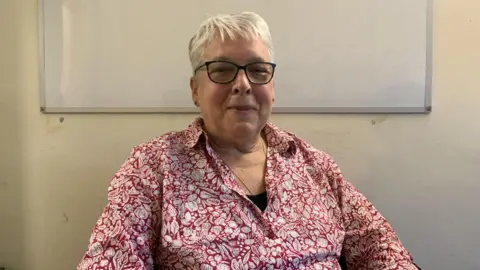
Maureen Storey has been involved helping victims since the 1970s and recalls the start of Sheffield Women's Aid: "A group of women had been trying to get the council to provide a property and they weren't getting anywhere so they squatted a house.
"It was very basic and they borrowed and begged stuff to furnish it.
"But women came with their children because they were desperate enough to do that and thinking back to those early days there was no health and safety.
"It was just a place for women to come for a while and work out what they wanted to do next."
She says times have very much changed and the charity's properties are now "very safe" and have to meet national standards.
"The services have changed radically since those early days," she adds.
Maureen says the first step for people who need help is to call one of the domestic abuse helplines.
"In the late 1970s police would turn up and literally say, 'oh it's just a domestic'. They'd talk to the perpetrator then would just leave, they wouldn't talk to the victim on her own.
"Nowadays there are protocols in place, there is a whole range of services available from a helpline through to emergency accommodation.
"We have lots of really important developments that hopefully have changed the landscape."
Listen to highlights from South Yorkshire on BBC Sounds, catch up with the latest episode of Look North
