Controversial regeneration plan decision quashed

 LDRS
LDRSA decision to give planning permission to a major regeneration scheme in Birmingham has been quashed at the High Court, the city council said.
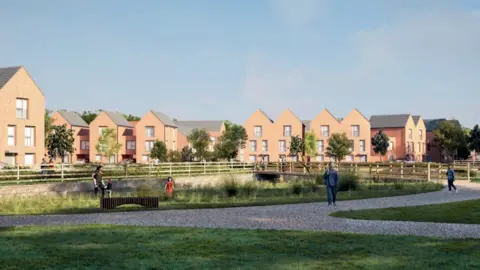
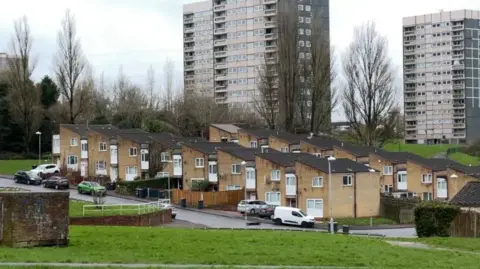
Previously, the authority had approved plans for a multimillion-pound regeneration of Druids Heath with up to 3,500 new homes, more green space and better transport links.
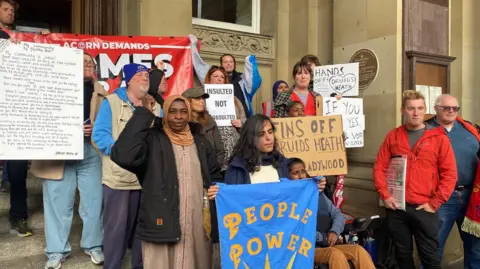
But residents had complained about being priced out of the area, the effect on their community and launched a legal challenge to overturn the decision.
The council confirmed it requested the court quash their original planning approval and a spokesperson said on Wednesday that had now been agreed.
The authority's plans were narrowly approved in October, despite anger from some residents.
The authority had committed to making 51% of future homes "affordable", about 1,785 properties in total.
However, only 400 of those were detailed in the planning application as social rented homes.
Such homes are owned and managed by local authorities or private-registered providers with target rents set annually by the government.
 BM3 Architecture
A legal challenge was then threatened by residents towards the end of last year, calling on the council to overturn the decision to grant outline planning permission for the scheme.
Central England Law Centre (CELC) argued that the authority failed to disclose the full financial viability assessment, which sets out whether a project can generate enough money from revenue to cover its cost, when the plans were approved.
The assessment was used to justify why the application only set out that about 11%, [400 homes] were to be affordable housing.
The council requested the court quash its decision, following the challenge.
"We can confirm our application to quash the outline planning application has been agreed, following a legal challenge from a small number of residents," a council spokesperson said.
"Now the basis of that challenge will be addressed by making the financial viability assessment for the scheme public."
The update means delays for the scheme, which will have to be brought back to the planning committee again for a decision.
Elayne Hill, chief executive of CELC, argued that the case "demonstrates why transparency matters".
"Where key information is withheld, communities are denied the opportunity to understand and scrutinise what is being proposed properly," she said.
The council had previously said the assessment contained commercially sensitive information that could not be released while the authority was in a process to identify their preferred partner for the scheme.
This meant that it was not available to the planning committee when they made their original decision.
This news was gathered by the Local Democracy Reporting Service which covers councils and other public service organisations.
Follow BBC Birmingham on BBC Sounds, Facebook, X and Instagram.
