Wheelchair camera 'is milestone for disabled film-makers'

 BBC
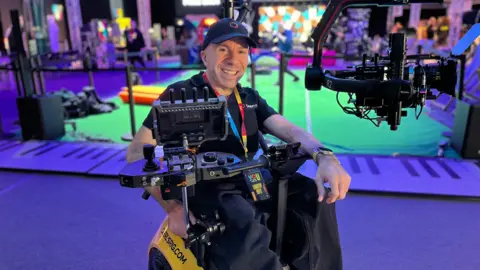
BBCA London film-maker with brittle bone disease has patented what he believes to be the world's first wheelchair camera system.
Chris Lynch, from Stratford, east London, worked with engineers to make filming more accessible. The specialist equipment attaches a Steadicam to the side of a wheelchair with a mount, with the operator using a control panel placed on their lap.
Lynch's system has already been used in productions like Channel 4's Paralympic Homecoming and BBC documentary, In the Driving Seat.
The 44-year-old said: "This is a milestone within the disabled community. It means that I can shoot and be a camera operator, something I've wanted to do for a long time."
Since 2007, Lynch has created a number of media companies specialising in documentaries and podcasts, but filming was always a problem.
"Filming wasn't accessible, so I decided to create a camera system that could be not only be viewed as a gateway to disabled filmmakers, but a product that would add production value to any set," Lynch said.
"I set up Diverse Made Media with a production arm because I wanted to make more of these wheelchair operated cameras and show aspiring disabled film-makers that production is possible for them."
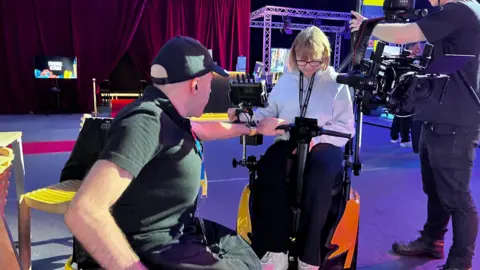
He worked with Jack Charge from Tilta, a company that specialises in cinematography equipment, and together they created the specialist kit.
Charge said: "This is a brand new system and is the first of its kind being mounted on to a wheelchair, which takes all the weight.
"It means that you have a wide variety of situations you can use this in like live broadcasts, music videos or even fast tracking shots for long periods."
Lynch is now showcasing the system to studios, film-makers and students.
Jasmine Larkman is a university student at Liverpool Media Academy in east London and has hemiplegia.
She had her first go on the kit while at an arts conference last week.
Larkman said: "I can't use my body on the right side, so with this kit there are so many ways you can use it. It's really accessible for lots of people."
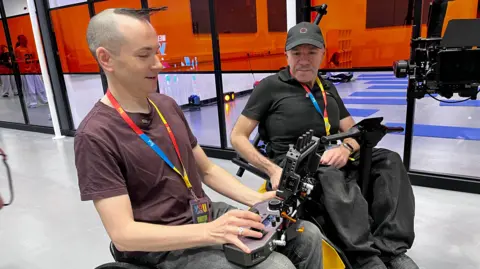
Owen Tooth, director for Eastenders, is the long-running soap's first wheelchair user to trial the system.
He said: "I'm most excited as a director, it opens up storytelling possibilities that were out of reach before.
"Looking at a system like this, there's so much I can do, it feels so freeing."
Lynch told the BBC that people within the disabled community had "resigned themselves to the fact that they can't do these tasks" and it has always been a barrier for them.
He added: "That has been embedded for many, many years.
"I'd love to see more and more people be able to access this equipment across the industry. It's exciting and I can't wait to see where it takes us."
Listen to the best of BBC Radio London on Sounds and follow BBC London on Facebook, X and Instagram. Send your story ideas to hello.bbclondon@bbc.co.uk
