'Hard to keep lights on' - Business owners cautiously welcome tariff ruling

 Danielle Kaye/BBC
As soon as she heard the US Supreme Court had struck down President Donald Trump's authority to impose sweeping global tariffs, Jenelle Peterson's mind raced to the possibilities for her toy business.
She might import more toys to the US and invest in designing new ones - things she had put on hold as Trump's levies on China, where her Canadian firm Wild Life Outdoor Adventures makes its products, took a 25% bite out of her profits last year.
Still, uncertainty about refunds and other tariff authorities that the Trump administration might leverage is keeping her on edge.
"I have a bit of reservation in too much celebration," she said. "But for us, every percentage point matters."
Many business owners greeted the Supreme Court's ruling with cautious optimism.
Their rejoicing was tempered by questions about a potentially complex process to obtain refunds for tariff fees they've already paid.Trump said on Friday he expected the issue to be tied up in court for years.
And the Trump administration could still leverage other tariff authorities that were not implicated in the ruling.
The Supreme Court case only covers duties that the Trump administration imposed using a 1977 law, the International Emergency Economic Powers Act (IEEPA).
On Friday, Trump said he planned to sign an executive order to impose a 10% global tariff, under a separate statute that allows the president to put import taxes of up to 15% in place for 150 days.
"We have other ways - numerous other ways," Trump told a White House briefing.
On Saturday, Trump announced in a Truth Social post that he would be raising that tariff amount to 15%.
Learning Resources, a family-owned educational toy maker, was among the businesses that challenged Trump's tariff policy - and received a ruling in its favour on Friday.
Rick Woldenberg, the firm's chief executive, told the BBC that he was unimpressed with the president's proposed alternatives to IEEPA tariffs.
"If the government is bound and determined to try to harm us through excessive taxes, I'm sure they'll find a way," Woldenberg said.
But he called the Supreme Court's ruling a "major victory".
After Trump's announcement of 10% tariffs on Friday, the Budget Lab at Yale University said that even with the IEEPA tariffs struck down, consumers and businesses would face an average effective tariff rate of at least 9.1% - the highest since 1946, excluding 2025.
That means tariff-related pain continues to loom over business decisions.
"Although bringing an end to most tariffs will undoubtedly benefit Main Street, we know that tariffs have already caused significant and irreparable harm to many small businesses," John Arensmeyer, chief executive of the Small Business Majority, an advocacy group, said in a statement on Friday.
"We hope that today's decision is a step forward for small businesses that need more certainty as well as relief from high prices in order to continue operating."
Trade associations representing larger companies also embraced the Supreme Court's decision, even amid persistent unease about the refund process and alternative tariff authorities.
The legal decision "provides much-needed certainty for US businesses and manufacturers, enabling global supply chains to operate without ambiguity," David French, an executive at the National Retail Federation, said in a statement.
"We urge the lower court to ensure a seamless process to refund the tariffs to US importers," French added.
The US Chamber of Commerce called the Supreme Court's ruling "welcome news for businesses and consumers".
Investors not out of the woods either
Reaction in the stock market to the Supreme Court's decision was favourable but relatively muted, as investors also weighed what might come next in the Trump administration's trade strategy.
The S&P 500 rose by 0.7% on Friday, while the technology-heavy Nasdaq index was about 0.9% higher.
"We do not expect the market to have a sustained reaction to this news on its own," said Lauren Goodwin, chief market strategist at New York Life Investments.
"The sector winners and losers from this news depend on whether and how rebates are processed, as well as the use of non-IEEPA tariffs from here," she added.
The relative calm in financial markets stood in contrast to one year ago, when Trump's chaotic tariff roll-out jolted Wall Street and led to weeks of volatile trading.
Since then, markets have largely taken tariff headlines in their stride.
But the risk of tariff-fuelled market volatility has not disappeared.
"Even if the administration replicates the overall level of tariffs using other means, the by-sector and by-country implications could end up looking quite different, which will create another bout of trade policy uncertainty for businesses, investors, and households," said Michael Pearce, chief US economist at Oxford Economics.
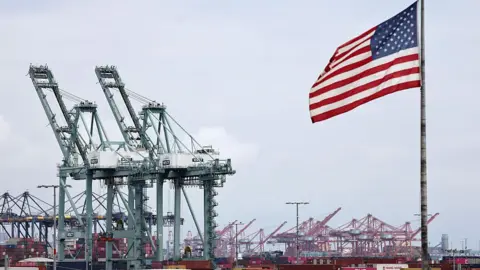 Getty Images
'So damaging'
Several recent economic analyses have found that US consumers and businesses bear the brunt of Trump's tariffs.
Firms, despite their trepidation about the Trump administration's next moves, noted that the Supreme Court's ruling on IEEPA tariffs could bring some relief to consumers.
Peterson held prices steady for six months after Trump returned to the White House. But she said she couldn't hold out forever. A knot-tying game now costs $19.99, up from $14.99.
"It's hard to keep the lights on," Peterson said.
She said she hopes to be able to bring her prices back down, if the ruling holds and tariff rates stabilise.
The ruling from the highest court in the US, she added, "sends a really good message that we can't have these insane fluctuations in tariff rates and economic policy, because it's so damaging to small businesses".
