Mum warns of 'botched' £150 filler that cost £700 to fix

 PA Media
A mother-of-two said she refused to go out for weeks after "botched" under-eye fillers left her in searing pain - and has now urged others considering similar treatments to do careful research.
Joanne, 48, said she chose a £150 treatment she spotted on social media after being quoted about £495 elsewhere, and later had to spend more than £700 having it corrected.
"I wished I'd done some more homework" the finance director from Altrincham, Greater Manchester, said.
Her warning comes as a poll commissioned by the Professional Standards Authority for Health and Social Care found 46% of 1,000 UK adults surveyed believed all aesthetic practitioners were regulated by law.
The non-surgical aesthetics industry - including providers of Botox, dermal fillers, and chemical peels - is largely unregulated. In the UK, anyone can legally perform many non-surgical procedures without medical qualifications.
Last year the government promised to develop a licensing system for England, but it is yet to be introduced.
'Felt rushed'
Joanne said she had previously had Botox, lip and cheek fillers and skin boosters, but began looking at further treatments because she felt she looked tired after having her second child.
She said she found the clinic through social media and was reassured by information about the products it used and its before-and-after photographs.
However, she said the cheap price was central to her decision.
She had been quoted about £495 for tear trough filler - injected beneath the eyes - elsewhere, while this particular clinic offered the same treatment for £150.
Joanne said the appointment felt "rushed" and claimed the practitioner continued adding filler despite her saying it felt painful and that there was a burning sensation beneath her eyes.
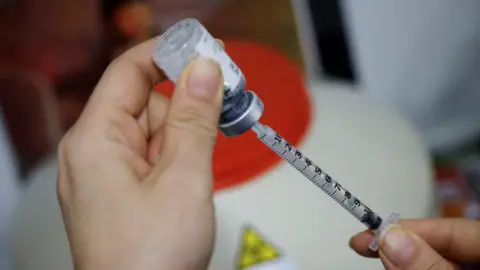 Reuters
She said she was told this was normal and was not shown a mirror until the procedure was over.
"When she finally gave me the mirror, my first thought was 'oh my goodness, I've just been mutilated. I just need to get out of here'," she said.
Joanne said that by the time she arrived home, the areas beneath her eyes looked like "two tree trunks".
She said she stayed at home for two weeks, asked her husband to do the school run and avoided socialising. She also said the experience affected her confidence at work and left her embarrassed when explaining it to her daughters.
Joanne said the filler could be dissolved, but corrective treatment cost more than £700 and she had to use savings to pay for it
"I felt so stupid that I'd not done the homework, thinking that I was saving money and that because it was an aesthetics procedure there was no risk involved," she said.
She said she would no longer choose a practitioner simply through social media and advised people to check qualifications, products, aftercare and complaints procedures before booking.
The PSA said their survey also revealed 29% of those seeking non-surgical cosmetic treatments relied on before-and-after photographs or testimonials on social media when choosing a practitioner.
Chairwoman Caroline Corby said the findings added to "growing evidence that gaps in the regulation of health and wellbeing services can put consumers at risk".
She advised people to check whether a practitioner belonged to a register carrying the PSA's quality mark, while acknowledging that registration could reduce rather than eliminate the risk of harm.
Botulinum toxin, commonly known by the brand Botox, is a prescription-only medicine.
Professional rules require an authorised prescriber to examine the patient in person and issue a prescription before treatment, according to a BBC investigation.
Facial dermal fillers are treated differently. England does not yet have a statutory licensing scheme covering everybody who may carry out the procedures, although some providers are regulated through another healthcare profession.
In August 2025, the government said it intended to introduce a local authority licensing system in England covering procedures including Botox and facial fillers, with requirements concerning training, safety and insurance.
A House of Commons committee said in February 2026 that the planned licensing system had not been implemented and urged ministers to accelerate the work.
Listen to the best of BBC Radio Manchester on Sounds and follow BBC Manchester on Facebook, X, and Instagram. You can also send story ideas via Whatsapp to 0808 100 2230.
