After months of acrimony, Colombia's Petro is about to meet Trump

 Getty Images
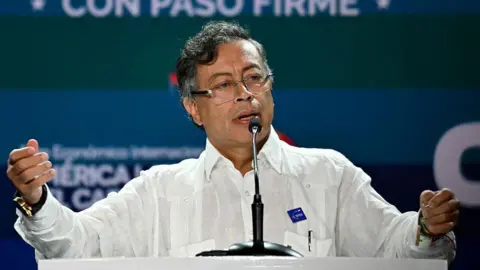
Colombian President Gustavo Petro is heading to Washington for a high-stakes trip to meet US President Donald Trump, the first in-person meeting between the two after months of escalating tensions and angry rhetoric.
Venezuela, drug trafficking, oil, security and US strikes on alleged drug vessels will be high on the agenda when they meet at the White House on Tuesday.
While the two men were cordial in a phone call after the 3 January US military operation to seize Venezuela's President Nicolás Maduro, Petro has since said he believes that there is a "real threat" of military action against Colombia.
Trump, for his part, has previously said that a military operation in Colombia "sounds good".
Tuesday's meeting follows months of the two leaders trading barbs - with Petro repeatedly criticising the repeat US strikes on the alleged drugs boats in the Caribbean and Pacific, as well as the White House's immigration policies.
In an interview with the BBC last month, Petro went as far as to compare US Immigration and Customs Enforcement (ICE) agents to "Nazi brigades" and accused the US of treating other countries as part of its "empire".
On the US side, Trump has accused Petro's government of not doing enough to stop the flow of cocaine heading north, and has vowed to expand strikes to land targets across the region.
But the acrimony seemed to dissipate following a "cordial" phone call between the two leaders, which a Colombian official later described as an 180-degree turn "from both sides".
According to diplomatic sources, one man - Rand Paul, US Senator for Kentucky - was instrumental in setting up the conversation.
"I believe in diplomacy and I thought our relations were going in the wrong way," the senator told the BBC. "And I'd like to see our relations improve."
Paul, who has sometimes clashed with Trump himself, added that he believed the upcoming meeting in Washington could build on the earlier dialogue between the two men.
Ahead of Tuesday's visit, Colombian Foreign Minister Rosa Yolanda Villavicencio said that much of the conversation would focus on shared US and Colombian concerns over security in Venezuela, with which Colombia shares a 1,367 mile (2,200km) border.
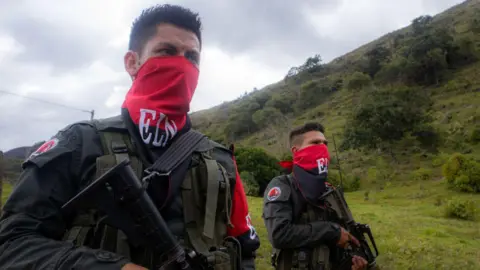
Much of that border is under the sway of the National Liberation Army, or ELN. This Colombian guerrilla group, which was founded in the 1960s, controls drug trafficking, extortion, contraband and illegal mining of gold and coltan in border states such as Zulia, Táchira, Apure, and Amazonas - and works with corrupt elements of the Venezuelan government.
While in Colombia the group operates against the government, in Venezuela it often serves the interests of the state, according to security analysts, and operates as a paramilitary-style organisation.
Insight Crime, a Medellin-based think-tank, estimates that 1,200 of the group's approximately 6,000 members operate in Venezuela, with a presence in eight of its 24 states.
"There will be a constructive conversation about the path forward for stabilising and securing the Venezuelan-Colombian border and US-Colombia relations," Democratic Senator Chris Coons told the BBC ahead of the Trump-Petro meeting.
 Getty Images
For Trump, addressing the threat of the ELN will be vital to ensuring security for US firms involved in Venezuela's oil industry after Maduro was seized. The removal of Maduro potentially creates an opportunity for a strategic partnership between him and Petro.
Elizabeth Dickinson, deputy director for Latin America at International Crisis Group, said the ELN had the potential to spoil those ambitions by targeting foreign investors and employees, as it has previously done in Colombia.
Money made by the ELN's mineral and drug trafficking operations, she explained, often included payments to elements of the Venezuelan military.
"That money flowing up and down the system through the Venezuelan armed forces is fundamental to its cohesion," she said. "Asking the same Venezuelan military to go after the ELN would be quite challenging because their interests... are largely aligned."
Following the fall of Maduro, Petro has already ordered 30,000 Colombian soldiers to the Venezuelan border to prevent the group from crossing over.
An equally pressing issue for the two leaders will be the fight against cocaine trafficking from Colombia, the drug's largest producer.
In November, Petro ordered a temporary pause of intelligence sharing with US security agencies after Trump's threats - making reference to the US boat attacks.
The US, for its part, has formally named Colombia as a country which has "demonstrably failed" to uphold its obligations to control drug trafficking, as part of its annual certification of whether several countries are fully co-operating with its counter-narcotics efforts.
It has also imposed sanctions on Colombian officials, including Petro and members of his family.
Despite the tensions, co-operation has continued between the two nations' militaries, as well as between the US Drug Enforcement Administration (DEA) and Colombian police.
"There is no fight against the cocaine trade without Colombia," said Jeremy McDermott, the co-director of Insight Crime." The threat to cut off Colombian intelligence to the US could also undermine all investigations."
Colombian officials have said that the visit will also serve as an opportunity to showcase their government's counter-narcotics efforts to a sceptical White House.
But even with multiple areas in which the two can cooperate, there still exists the potential for an Oval Office clash of the sort that the presidents of Ukraine and South Africa both experienced with Trump last year.
"Trump loves you one day, dislikes you the next day and reverts to loving you a couple days after," said Brett Bruen, a former diplomat who now runs the Global Situation Room, a Washington-based strategic communications firm.
"My suspicion is that Petro will walk in with some concessions to avoid Trump's ire and any punitive measures," he added. "But one never knows what side of the bed Trump woke up on."
But for Petro, even an ugly encounter could be beneficial.
His presidential term is over in August, and the outcome of the meeting could impact the electoral chances of the man he backs to replace him, Senator Iván Cepeda.
"In some ways, he's kind of in a win-win situation," said Michael Shifter, a Latin American studies professor at Georgetown and the former head of the Inter-American Dialogue. "If it goes well, he takes the air out of one of the core arguments of the opposition, that the left can't have a good relationship with the US.
"If it doesn't, it's not going to cost him his base. He's protecting national sovereignty and trying to negotiate with Trump," he added. "He could turn that in his favour."
