Ambulance service pilots AI tool for patient care

 South East Coast Ambulance Service
South East Coast Ambulance Service (Secamb) is piloting Artificial Intelligence (AI) in a bid to improve efficiency and free up clinicians' time to help more patients.
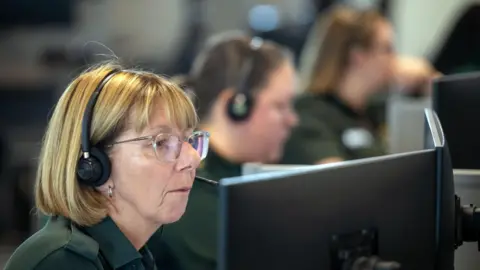
Clinicians at its Emergency Operations Centres in Crawley and Medway are trialling the AI tool to transcribe clinicians' and patients' conversations into "structured medical notes".
The notes would be checked and approved by the clinician to reduce time spent on writing up notes after calls.
Clinical operations manager for integrated care, Emma Webber, said: "The technology should support our staff to focus more on the patient and remove some of the administration processes that can be time-consuming."
An ambulance service spokesperson told the BBC clinicians would continue to take notes, during their consultation with patients, alongside the AI technology to ensure consistency.
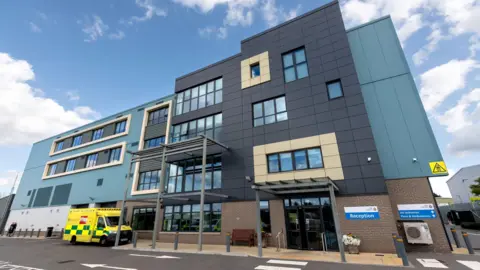
Secamb covers Brighton and Hove, East Sussex, West Sussex, Kent, Surrey, and North East Hampshire.
It added the technology, developed by Tortus, was first tested by clinicians at Great Ormond Street Hospital.
 South East Coast Ambulance Service
According to the company's website, St George's University Hospitals, London Ambulance Service and University College London Hospitals are also using Tortus' technology.
Secamb's chief digital information officer, Nick Roberts, said: "We are committed to trialling innovative technology to establish ways we can improve efficiency and patient care."
Mr Roberts says AI applications are already "changing the way we work across all industries, including healthcare".
"It is important we take time to learn about the opportunities it can offer and how to safely use the technology to improve patient care," he added.
The ambulance service added the pilot is due to finish in February 2026, after which they would consider how to "best integrate such technology in the future".
Dr Dominic Pimenta, chief executive of Tortus, says the AI tool "undergoes rigorous testing" to mitigate errors.
"Our models are continuously refined to address challenges such as accents, background noise, and varying audio quality."
He says they have integrated specialist hardware into telephone lines to ensure audio quality is preserved.
"Our real-time surveillance system automatically flags and reviews any serious clinical discrepancies," he added.
