Glen Rosa ferry costs rise by £12.5m after latest six-month delay

 Christopher Brindle
A six-month delay to the delivery of a long overdue Calmac ferry has added £12.5m to the overall cost.
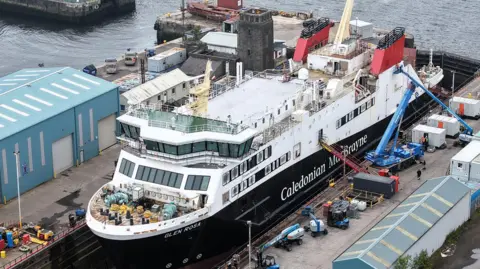
The nationalised Ferguson shipyard confirmed the delay for MV Glen Rosa before Christmas but has now given MSPs details of extra costs.
The ship, the second of two dual fuel ferries with a long and troubled history, was originally due for delivery in 2018 but will not be ready until the end of this year.
The cost of completing the ship since the yard was nationalised in 2019 has now risen to £197.5m. The Scottish government described the latest delay and rise as "very disappointing".
The revised estimates were confirmed in a letter from Ferguson chief executive Graeme Thomson to the Scottish Parliament's Net Zero, Energy and Transport Committee.
He wrote: "Although this position is regrettable, we are confident in the updated timeline and cost forecast.
"We look forward to informing the committee on our progress in our next update."
The ferry and its identical sister vessel MV Glen Sannox have been beset by design challenges and disputes over costs since the contract to build them was awarded in 2015.
MV Glen Rosa was launched from the slipway nearly two years ago, but fitting out work has taken far longer than expected as efforts were concentrated on getting Glen Sannox into service.
Having been moored at the quayside for around 18 months, a dry dock inspection last summer revealed corrosion and paint coating problems that would require another extended dry docking in order to remedy.
In December a letter to Holyrood's net zero, energy and transport committee said difficulties securing a slot for the work meant delivery would have to be pushed back to the fourth quarter of 2026.
In a new update on the cost implications it said the delay would add another £7m to the bill, plus £5.5m of contingency funding.
The two ferries were supposed to be built for £97m, but was the project was already about £100m overbudget by the time the shipyard fell back into administration in 2019, and was later nationalised.
The total cost of both ships is now approaching £500m if you include £83m that was paid out prior to nationalisation and £45m of government loans that were largely written off.
'Never-ending ferries fiasco'
The latest delay and costs confirmation prompted criticism from opposition parties.
Scottish Conservative transport spokesperson Sue Webber said "hard-pressed taxpayers" were paying the price for "the SNP's never-ending ferries fiasco".
"Islanders have been let down at every turn by this shameful SNP government, but not one nationalist minister has been held accountable," she said.
"The buck stops with John Swinney. He must explain to Scots how much more of their money he's prepared to pour down the drain."
Scottish Labour's Daniel Johnson said: "This is yet another hit in the pocket for taxpayers, who have already forked out far more on these ferries than should have been required.
"SNP ministers have overseen this fiasco from the start, with Nicola Sturgeon even posing next to a ferry with painted-on windows for a fake-launch event in 2017.
"The truth is that the skilled and dedicated workers at Ferguson Marine have been failed time and time again by SNP chaos and incompetence."
Scottish Liberal Democrat economy spokesperson Jamie Greene said no minister had ever resigned over the ferries "scandal" and described it as a "massive display of arrogance that people in the west of Scotland won't forget."
Deputy First Minister Kate Forbes also responded to the news.
"While I understand the final stages of building and testing a complex vessel are highly technical - and some risks only become clear at this point in the process - the further delay and increased costs are still very disappointing, particularly for island communities which rely on ferry services," she said.
"The Scottish government is carefully assessing the information provided to understand the full implications of the revised timetable and costs.
"We will continue to hold Ferguson Marine to account for delivery, cost control and full transparency as the project moves towards completion," she added.
The reasons for the long-running problems with the ships are complicated and fiercely contested.
They are the first LNG-powered vessels of their type ever built by a UK shipyard, and the specifications for them were also demanding in other respects.
The former owners of the shipyard claimed government-owned ferries agency CMAL had botched the pre-contract concept design and feasibility work, interfered with the design process and then refused to pay legitimate claims for extra costs.
CMAL contested this, claiming the shipyard's new management had simply underestimated the complexity of the task they had taken on, and made poor decisions in their build strategy.
In 2023, three years after the stalemate saw the firm taken into public ownership, a due diligence review commissioned by the Scottish government said it would be cheaper to scrap Glen Rosa and order a new ferry.
Neil Gray, who was wellbeing economy minister at the time, rejected that on grounds that it would lead to further delays in securing a new vessel, and cause economic damage.
