Government confirms major shake-up for Norfolk

 BBC
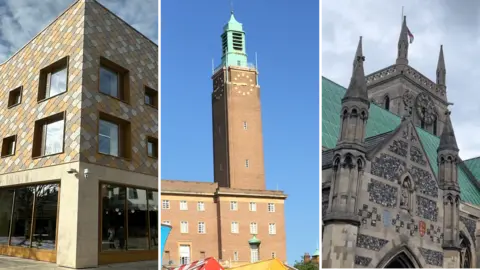
BBCA major shake-up of local government has been confirmed by ministers which will see all Norfolk councils scrapped and replaced by three authorities.
The seven district councils and one county council were all going to be abolished under government plans, but what would replace them had been hotly contested.
The county council said only one body for all of Norfolk would save taxpayers £39.8m a year and be more efficient.
But most of the districts wanted three, arguing one large authority would lack a proper connection with local people.
Local Government Secretary Steve Reed said the reforms would help in "driving economic growth".
Why are the changes happening?
 Future Norfolk
When Labour came to power, it said reforming local government by merging councils into unitary authorities would save money while improving services.
Currently in Norfolk the running of local services is split between the county council and districts.
The county council is responsible for areas including adult and children's social care, library services and roads – while the districts cover things like refuse collection, planning and leisure facilities.
It campaigned for one authority to manage everything, with the argument being it would save money and cut duplication.
However, six of the districts successfully argued that three councils – centred on Norwich, King's Lynn and Great Yarmouth – would be more connected to local voters.
What will the new council areas be?
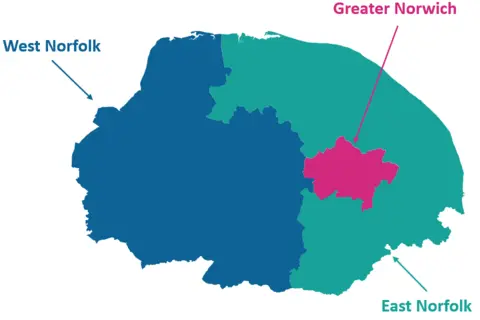
East Norfolk Council will consist of the existing Great Yarmouth and North Norfolk councils, along with parts of Broadland and South Norfolk.
West Norfolk Council will be made up of the current Breckland and King's Lynn and West Norfolk councils, along with parts of South Norfolk.
Greater Norwich Council will expand the existing city authority by adding some sections of Broadland and South Norfolk.
What has been the reaction?
 Paul Moseley/BBC
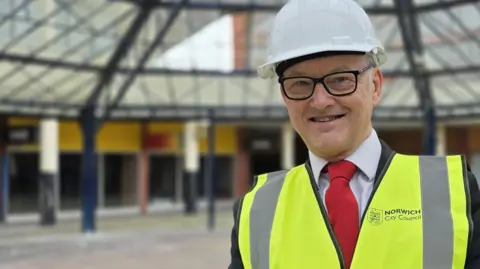
Norwich City Council has long been keen to run itself separately from the rest of Norfolk, and Labour leader Mike Stonard warmly welcomed the news: "We know that when Norwich succeeds, Norfolk succeeds."
Alistair Beales, the independent leader of King's Lynn and West Norfolk, also called it "a positive decision".
The decision was also backed by Broadland's Liberal Democrat leader Sue Holland and Breckland's Conservative leader Sam Chapman-Allen.
However, South Norfolk's Tory leader Daniel Elmer – who had argued for the county to be split into two authorities – said the plan was "disastrous".
"This is not a practical decision, it's not a cost-effective decision… It is doomed to failure."
 Qays Najim/BBC
In Great Yarmouth, Conservative Carl Smith said he was "not really happy" as he had never supported the reorganisation.
"The big thing we've got to do now is all work together to deliver these unitary councils for the benefit of the residents of Norfolk," he said.
North Norfolk's Liberal Democrat leader Tim Adams said the decision was the best possible result for his area but repeated an earlier warning that a new council might have to cut back some services.
Meanwhile, Kay Mason Billig, the Tory leader of the county council, said she was concerned about the viability of smaller councils and how they would handle services like social care.
She also warned three councils would face increased costs as, for example, they would each need a director of adult social care.
"By having a single unitary, you actually do make considerable savings. If you have three, we couldn't see how this was going to cost any less," she explained.
When will things change?
Elections for the authorities will take place in May 2027, with the new councils formally taking over responsibilities a year later.
Follow Norfolk news on BBC Sounds, Facebook, Instagram and X.
