Doctors announce six-day strike in England as talks break down

 Getty Images
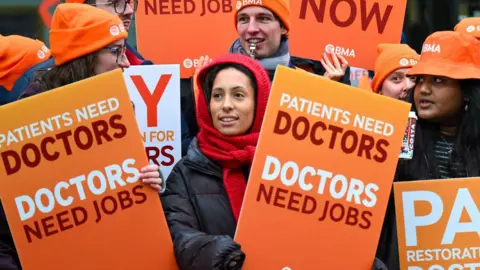
Resident doctors are to stage a six-day strike in England next month after talks broke down between the union, the British Medical Association (BMA), and government.
The BMA said it was taking action as the government had not done enough to address their pay claims and concerns about job shortages.
The strike - one of the longest of the dispute - comes after more than two months of talks since the new year.
It will start at 07:00 GMT on 7 April, straight after the Easter bank holiday weekend - and will be the 15th walkout since March 2023.
The talks broke down as it emerged doctors were to be given a 3.5% pay rise this year. The increase was recommended by the independent pay review body and accepted by government.
But the BMA described the award as a "crushing blow" for doctors. It will be given to all doctors, not just resident doctors - who were previously known as junior doctors.
On top of this, the government had also offered to cover some out-of-pocket expenses resident doctors face, including exam fees, as well as increase the number of training posts to address what the BMA has described as a jobs shortage at the start of year three of their training.
And resident doctors were also to get the opportunity to move up through the pay bands more quickly - there are five different pay points starting at nearly £39,000, rising to nearly £74,000.
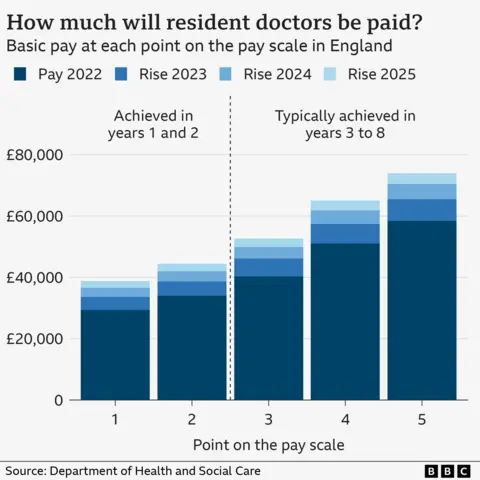
But Dr Jack Fletcher, from the BMA, said what was on offer would mean further pay erosion given inflation was set to increase because of global events - economists predict the Iran war will drive up prices.
"We have been negotiating in good faith for weeks," he said.
"We are simply not going to put an offer to doctors that risks locking in further erosion of pay at a time when doctors continue to leave the UK for other countries."
Health Secretary Wes Streeting said the BMA's expectations were "beyond reasonable and realistic".
"It is enormously disappointing for NHS patients and staff, that the BMA has rejected this offer," he said.
"This government has pulled every available lever to put forward a generous package that would have transformed the working lives and career prospects of resident doctors."
The walkout will be the joint longest of the dispute - only once before have resident doctors taken part in a six-day strike.
Resident doctors make up nearly half of medics working in the NHS - two thirds of them are BMA members.
The two sides have been in talks on-and-off for the past year.
Streeting has always maintained he will not discuss pay as doctors have received pay rises totalling nearly 30% over the past three years.
The BMA argues that, despite the pay rises, resident doctors' pay is still a fifth lower than it was in 2008, once inflation is taken into account.
The union has also claimed there is a jobs shortage when doctors move into specialist training at the start of year three - this is when they choose what area of medicine, such as general practice or surgery, they want to specialise in.
Last summer there were 30,000 applicants for around 10,000 jobs, although some of those were doctors applying from abroad.
