How St Patrick left his mark on the Isle of Man

 CULTURE VANNIN
Each year on 17 March Irish-themed celebrations take place to commemorate the patron saint of Ireland, St Patrick.
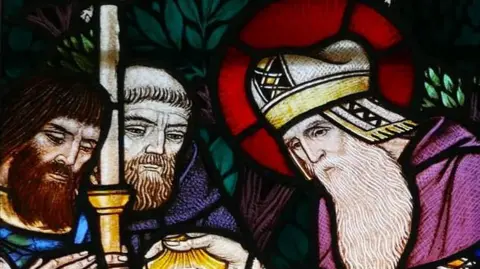
Most famed for his role in bringing Christianity to Ireland - and banishing snakes from the emerald isle of course - his name is also strongly etched in the folklore and place names of the Isle of Man.
Why did St Patrick visit Manx shores?
Thought to have been born in Wales during the Roman era in about 373, Patrick was enslaved as a teenager and taken to Ireland.
After being reunited with his family, as an adult he is said to have joined the priesthood before returning to Ireland as a missionary in 432.
James Franklin, of Culture Vannin, said the Isle of Man's association with St Patrick, which dates to about 444, was "pretty much the same".
"The story is the same between us and Ireland – that he came here, brought Christianity, banished snakes and his mark is left all over the Isle of Man."
This was done in folklore, place names and in the dedications of churches and holy wells.
"From that," Franklin said, "we know that he had an extremely strong place in Manx hearts back in the day."
Although there were historical and geographical accounts of St Patrick being on the Isle of Man, he said the "space between folklore and history is very thin".
 MANX SCENES
What happened to the snakes?
It is generally accepted that the lack of snakes on the Isle of Man - like Ireland - is due to geographical isolation and the cold climate.
Folklore says differently, however.
Franklin said the great thing about the St Patrick folklore was that there was "so much of it".
While there were several tales of where St Patrick landed on the island, and from where he drove away the snakes, one in particular even made its way into the fairytales of Sophia Morrison.
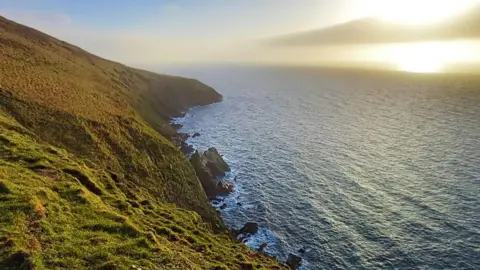
That story goes that he rode over the sea to the Isle of Man on a horse, where he became lost in the mist.
Alerted by the island's animals he was in danger of being eaten by a sea-beast, he turned it to stone and leapt on to Peel Hill where a holy well sprung up.
It was from there he banished "venomous beasts, visible devils, and a multitude of magicians".
"A lovely part of the tale is that the sea-beast is visible there in the sea," Franklin said.
"It's a large rock with its pointed back rearing out of the sea, and its head visible at low tide."
 CULTURE VANNIN
What did St Patrick give his name to?
As well as the tales passed down over time, St Patrick's name remains ever present on the island.
The Parish of Patrick on the west of the island, St Patrick's Isle, which is home to Peel Castle, and the southern village of Ballakilpheric - originating from the Manx Gaelic phrase Balley Keeill Pherick meaning the farm of the Church of Patrick - all bear his name.
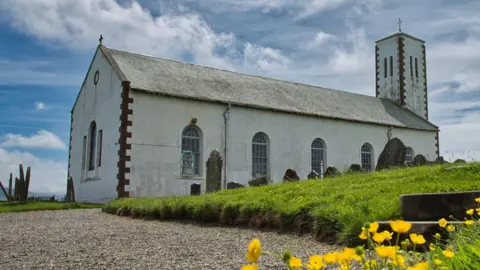
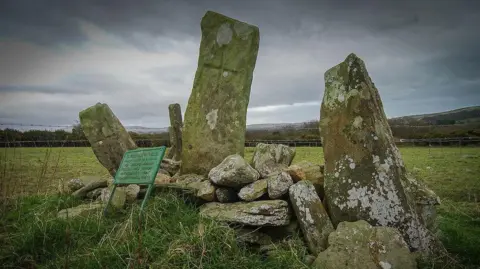
On top of that, the parish church in Jurby is dedicated to him, as are 18 different keeills and 13 holy wells situated across the Isle of Man.
Franklin said that was more than any other named saint in the island, showing that "across the Isle of Man he was the most important".
 MANX SCENES
Why does his legacy go on?
The "special relationship" between the Isle of Man and St Patrick was "very resonant with Manx people in the past", Franklin said, but it was also one that remained beyond the reformation in the early 16th Century.
"Manx people clung to an understanding of these places in the landscape as having a spiritual meaning and persistence beyond what would have been the Anglican Church teachings at that time," he explained.
"This is seen in the folklore - people very much felt connected to St Patrick as a spiritual figure.
"For them it worked and it was theirs, so it wasn't really a question of giving it up or not.
"Still today some of the sites have meaning and resonance, even independently of the Christian faith."
Read more stories from the Isle of Man on the BBC, watch BBC North West Tonight on BBC iPlayer and follow BBC Isle of Man on Facebook and X.
