Desperate times are behind Sarwar's PM resignation call

 Getty Images
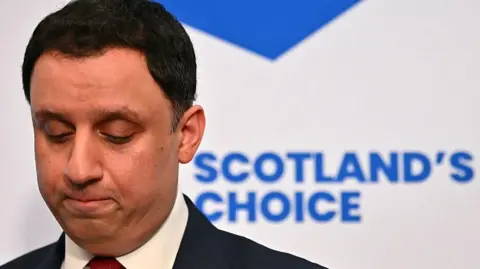
Desperate times call for desperate measures, or so the saying goes. That seems to be the mode in which Scottish Labour leader Anas Sarwar is currently operating.
For desperate times, see the trend in Scottish opinion polling that suggests Labour is facing a huge challenge to close the gap with the SNP ahead of the Holyrood elections.
See also the toxic Downing Street drama over Peter Mandelson's appointment as UK ambassador to Washington at a time when something of his friendship with Jeffrey Epstein was known.
This is seen by many in Scottish Labour as the latest in a long line of blunders by Sir Keir Starmer that are wrecking their chances of wresting power from the SNP.
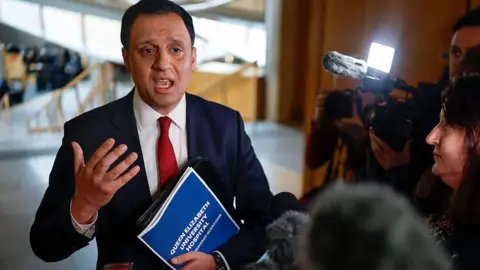
For desperate measures, there is no better example than the extraordinary news conference Sarwar called on Monday to appeal for the prime minister to stand down.
He said there had been "too many mistakes" in Number 10 and that he had to speak honestly and put Scottish interests first.
However difficult it makes internal party relations, Sarwar's team hopes the Scottish public will view things more favourably.
It is also possible that some voters will dislike any whiff of disloyalty and division and express themselves accordingly.
The next run of opinion polls will be closely examined for any sign of movement either way.
With his announcement, Sarwar has asserted a degree of independence - that he is his own man, rather than Starmer's branch office manager in Scotland.
Sarwar has said he feels "liberated" by the position he has taken and has retracted nothing.
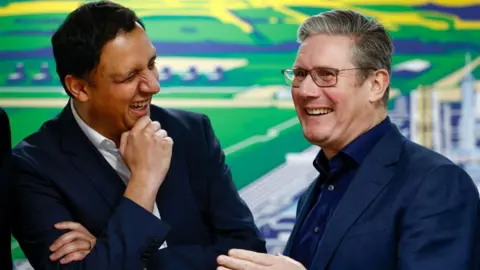
By contrast, Starmer's been the model of magnanimity - offering Sarwar his "100%" support.
I'm not sure how gritted his teeth were at the time and can only imagine how awkward their next joint public appearance will be.
 Getty Images
It has emerged that Sarwar had conversations with key Labour figures in and beyond the Cabinet last weekend - including Wes Streeting, Angela Rayner and Lucy Powell.
Sarwar did not apparently share details of what he was about to do. He has specifically denied any attempt to coordinate a coup.
If that was what this was supposed to be, it would rightly be judged a spectacular failure because no one of rank followed his example.
As soon as Sarwar called for Starmer to go, cabinet ministers began posting social media messages backing the PM.
A meeting of the parliamentary Labour party at Westminster also rallied behind him. Any senior Labour figure who might privately agree with the Scottish party leader lacked the courage to say so publicly.
There was speculation that the first minister of Wales, Eluned Morgan, was the most likely figure to "do a Sarwar" because she has been more critical of Starmer's leadership than most.
Instead, she fell into line, with some believing that if she had called for the PM to go it would have torn apart the fractious group Morgan leads in Cardiff Bay.
The party in Wales is also more dependant on UK Labour funding than the Scottish party, which is understood to have raised enough to pay for its own Holyrood election campaign.
That the prime minister needed a coordinated show of support exposed his vulnerability but it was enough to secure his position in the short term.
There are difficult electoral tests to come.
These include a Westminster by-election in Greater Manchester, as well as the May elections for the Scottish and Welsh Parliaments and English councils.
The publication of the vetting details for the Mandelson appointment could bring further embarrassment.
 Getty Images
Starmer remains a very unpopular prime minister and Sarwar's fundamental breach of their political relationship has exposed wider divisions within Scottish Labour.
All the party's MSPs who have spoken have endorsed the Sarwar position, with only two Scottish Labour MPs doing the same.
It's not all about being on one side or the other. There are MPs who will fudge by saying they support both leaders.
There is also a "why now?" camp - MPs who think it is only a matter of time before Starmer is forced out but question the wisdom of seeking to replace him at this stage.
Starmer's critics at Westminster and Holyrood are operating on different timescales.
MPs have three years before the next election. MSPs only have three months.
If you want the PM's job, you might prefer that he takes the blame for any electoral setbacks Labour suffers before making any big moves.
If you are fighting those elections in the hope of becoming Scotland's next first minister and you believe Starmer is holding you back, May is too late.
That's why Sarwar spoke out when he did. He believes that doing so brings him much closer in line with public opinion, however unpopular it makes him with some colleagues.
Sarwar's calculation has been that in the circumstances he faces doing nothing was not an option and that maybe, just maybe, doing something bold could improve Scottish Labour's position.
That may turn out to be a terrible mistake - but it's a risk he decided was worth taking.
Desperate times. Desperate measures.
