Will 'scunnered' voters decide Scotland's election?

 Getty Images
"I've voted since I was 18, and I'm 64 now, and I'm not doing it this year. I'm done.
"That's my protest - none of them are worth bothering about."
Those were the words of Ottilie Fraser, who spoke to BBC Scotland in Perth.
They reflect a broader feeling about politics at the moment - a disenchantment commonly referred to as "the scunner factor".
With pollsters detecting a lukewarm reception for every party and forecasting a decline in voter turnout, how could this apathy affect the result?
Politics has never been a particularly popular profession.
But the mood of the electorate towards those who aspire to represent and lead them has scarcely felt so negative.
Luke Tryl, director of polling firm More in Common, said this week that focus groups he had just conducted in Scotland were "possibly the most unenthusiastic or 'meh' I've ever experienced people be about their choices in an election".
Is it just vibes, or is there data to back up the idea that this is becoming a "mehlection"?
Warning lights about public mood have been flashing for some time.
The Scottish government's own regular public insight monitor, run by YouGov, found 43% of people reporting "high" levels of anxiety, 79% confessing concerns about their personal finances, and low trust that politicians can do anything about the cost of living, pressure on the NHS and climate change.
Polls by multiple different firms suggest this has a knock-on effect on the election.
Professor Sir John Curtice highlighted that a recent Survation poll had found the number of undecided voters had doubled from the same point in the 2021 campaign.
And an Ipsos survey found that 42% of those who had picked a party this year said they might change their mind - up from 25% in 2021.
Both firms used the same questions and the same methodology at the same point in the 2021 and 2026 campaigns.
Prof Curtice said: "It's not just the one in five who are undecided, even among those who give an answer there is another two in five who are saying I am not quite sure, I might change my mind, I might go somewhere else."
 Getty Images
This suggests that there is everything to play for in the final week of the campaign, if - and it's a huge if - parties can get people to come out and cast a ballot.
But polling also suggests the number of people who will do so is set to fall.
Prof Ailsa Henderson pointed to the percentage of people who say they are "10 out of 10 likely to vote" being down by 10 percentage points in Yougov polls and five points in Ipsos ones.
She said: "That figure is always higher than actual turnout - so what that suggests is we would be looking at turnout in the low fifties to mid fifties."
However it should be noted that Holyrood turnout hit a record high in 2021, having mostly hovered in the 50s since 1999.
It may just be reverting back to normal after a period in which voters have been trotting back and forth to the ballot box with great regularity.
Since participation hit 85% in the 2014 independence referendum, Scottish voters have taken part in no fewer than 10 national votes - for Holyrood, Westminster, councils, the European Parliament and the Brexit referendum.
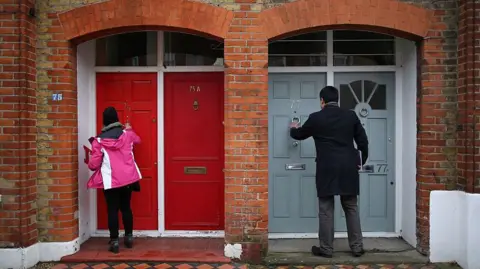
Who actually turns out to vote is going to be key in this election - which is why parties are dedicating more and more time to their ground operation, with activists out knocking on doors in favourable areas as polling day approaches.
The truth is that people don't seem to overwhelmingly like any of the parties on offer.
Another Ipsos poll measured satisfaction levels with individual parties, and none of the six on offer came out with a net positive rating.
All had more people recording an unfavourable view of them compared to a favourable one.
The same is true of the people who lead the parties.
A survey by Mark Diffley's company found the best leader approval rating was -4, and that some are struggling for basic recognition.
It possibly doesn't help that a lot of the debates between leaders look very similar.
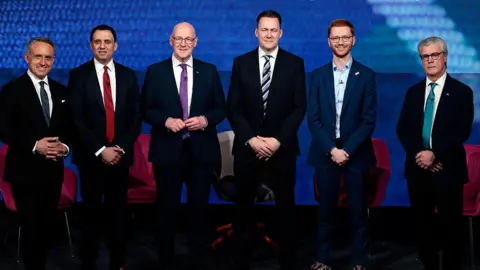
Other than Green co-leader Gillian Mackay and the occasional appearance by Mairi McAllan, who seems to be the SNP's deputy leader in all but actual title, big set-piece events have largely featured the same six men in suits shouting over each other.
 Getty Images
What do political parties do about this wave of apathy and anger?
It would take a fairly heroic effort to turn around in the current atmosphere and try to convince people of the inherent good in politics.
Parties which have been in opposition at Holyrood - like Labour, the Conservatives and Lib Dems - are all banging the drum for change after 19 years of SNP government, insisting services have gone downhill. Their leaflets frequently bear bar charts declaring that only they can beat the SNP in a particular seat.
Reform UK obviously revels in its role as an anti-establishment vehicle, attempting to be the champion of the scunnered.
And even the incumbent SNP is working on redirecting the anger of voters.
In particular the party is endeavouring to position itself as the anti-Keir Starmer, anti-Reform UK vote, with press releases constantly urging voters to back the SNP to "sack Starmer" and "lock Farage out of power".
The Greens too have been keen to go after Reform and paint themselves as the progressive alternative for those who want change.
There is a logic to this, from all concerned - a decent chunk of Scots may vote tactically, and framing contests as being about stopping someone they don't like may be easier in the current climate than persuading them to fall in love with your own messages.
And perhaps the latest difficulties for the Labour UK government over the selection of Peter Mandelson as US ambassador is an open goal that no opponent could resist.
But a continuing air of scandal and division around politics may not really serve any party well at the end of the day, if it continues to ramp up voter disaffection with the profession as a whole.
 Getty Images
It has also been a pretty cynical campaign at times.
Time and again we hear people complain that they are sick of politicians who over-promise and under-deliver.
And yet parties persist in promising things which look impracticable at best.
The SNP is leading with a plan to cap food prices which the Fraser of Allander Institute says it's "almost certain" they do not have the power to deliver, and which looks more calculated to prompt a "stooshie".
Meanwhile the Institute for Fiscal Studies says the tax cuts proposed by Reform UK "do not stand up to scrutiny" and that Conservative tax plans could only be delivered via cuts to frontline services.
Labour's promise to build 25,000 new homes a year looks extremely ambitious when industry body Homes for Scotland warned that a lack of useable land could actually see new build completions plummet.
Every party has also made a pledge of some sort to reduce energy bills, which they can exert precious little influence over in a global marketplace while key powers lie at Westminster.
Talking of influence, the Lib Dems and Greens are hoping to wield some over whoever ends up forming the government - perhaps even being part of that government.
Their manifestos - which also include plenty of pricey policies - read like a menu of options for budget talks and negotiations with whoever ends up in charge.
However the Diffley Partnership poll mentioned above found that only 18% of respondents would be in favour of a coalition government, and 15% picked the idea of parties working together on an issue-by-issue basis.

On the bright side, parties are actually offering a very broad range of policies, as can be seen in BBC Scotland's handy interactive guide.
Voters are paying attention too - 70% told an Ipsos survey that they had been following the campaign very or fairly closely.
There are also more options for them than ever before.
There are 440 candidates standing in constituency races, and no fewer than 29 different parties contesting the eight regional lists.
Which of those parties can best overcome the "scunner factor" - or successfully harness it - is going to be critical in how those contests play out.
