Work on A38 expansion expected to start in 2030

 National Highways
A major project to cut congestion and increase the capacity of the A38 in Derby is not expected to start until 2030.
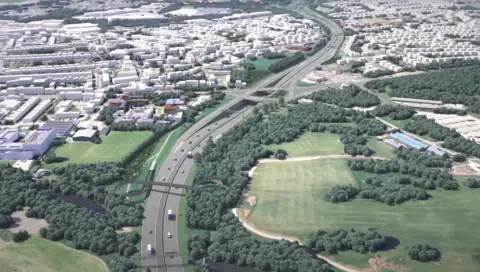
The estimated £600m scheme to create flyovers and underpasses at the Little Eaton, Markeaton and Kingsway roundabouts, as well as widened roads, was approved by the government in July.
However it has been branded "a waste of money" by a local campaign group which says the funding would be better spent on "infrastructure that reduces car dependency and protects nature".
The government said the expansion would provide "smoother and safer journeys" for motorists, while local council leaders said it was a "vital boost for Derby's economy".
The scheme is part of the Department for Transport's (DfT) £27bn road investment strategy for highways improvements across England.
The project has been designed to cut congestion on the stretch of the A38 where local traffic meets vehicles travelling between Birmingham and the M1.
A public consultation on how to improve the road started in 2001, but the project has been repeatedly paused, leading to the plans being redesigned and then challenged in court by campaigners.
The DfT has now told the Local Democracy Reporting Service that there was a confirmed time frame for when works are set to start.
It said it was expected to begin during the second part of the next phase of road improvements, which will run from 2030 to 2031.
According to National Highways, construction is expected to last four years.
 Adrian Howlett
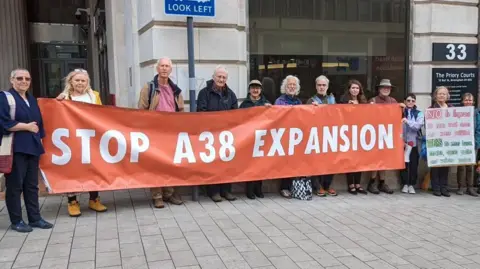
Campaign group Stop The A38 Expansion said the plans would lead to more traffic problems, increase air pollution and result in thousands of trees being destroyed, as well as "years of disruptive roadworks".
Campaigner Clare Wood said the government plans to start work but it "still hasn't published a full business case".
"The infrastructure we need is infrastructure that reduces car dependency, protects nature, and supports genuinely sustainable housing and land use," she said.
"Instead, we are being asked to spend over £600m destroying centuries-old trees, damaging local wildlife sites, building over parkland and agricultural land, increasing pollution and widening roads through Derby, on a scheme whose own economic case has collapsed."
Transport Action Network, which calls for better and more sustainable transport, has also criticised the approval.
While it supports the increased budget and renewing the ageing road network, it said the strategy was "based on outdated traffic forecasts".
"This has led to the inclusion of a number of poor value road schemes, such as the A38 Derby Junctions and A66 Northern Trans Pennine, that are more likely to increase congestion than solve it," a spokesperson for the network said.
Carmel Swan, cabinet member for transport at Derby City Council, said: "By upgrading key junctions around Derby, this funding will make journeys safer, smoother and more predictable for drivers, whilst keeping our local economy moving."
Listen to BBC Radio Derby on Sounds and follow BBC Derby on Facebook, on X, or on Instagram. Send your story ideas to eastmidsnews@bbc.co.uk or via WhatsApp on 0808 100 2210.
