Consultant can see the day 'HIV will be cured'

 BBC
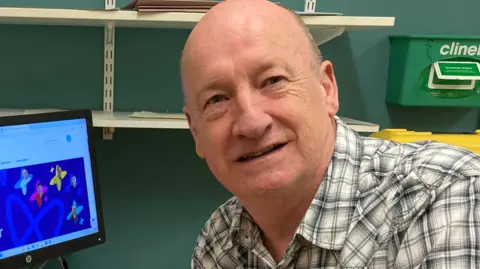
BBCA consultant physician who has spent almost 40 years treating infectious diseases says he can see the day HIV will be cured.
Dr Brendan McCarron, 64, who now works at the James Cook Hospital in Middlesbrough, said he saw "a lot of deaths" in the 1980s and '90s when he was treating patients with the disease in Glasgow.
He said the development of antiviral therapy in 1996 had been a "miracle" and praised the work of figures like Diana, Princess of Wales, in changing attitudes to HIV/Aids.
"With the treatment we have, we are expecting a long healthy life and most of them, I tell them, by the time they get to die, be it 50, 60, 70 years' time, HIV will be cured," Dr McCarron said.
HIV, or human immunodeficiency virus, weakens the immune system and increases the risk of serious illness, according to the NHS.
It is spread by infected body fluids getting into your bloodstream.
Aids (acquired immune deficiency syndrome), or late-stage HIV, is the name for a collection of serious illnesses caused by HIV, and there is currently no cure.
Dr McCarron qualified in 1985 and started working in infectious diseases in 1986, where he said he saw the "whole spectrum of community" coming in with the illnesses.
"For the first 10 years of that epidemic, I would attend a lot of funerals, see a lot of deaths, see a lot of young people dying," he said.
 PA Media
Dr McCarron said a lot of things happened in the late 1980s which changed attitudes, including government campaigns and an EastEnders storyline where character Mark Fowler had the illness.
"Then it was Princess Diana, Rock Hudson, Freddie Mercury and it brought it to people's front door," he said.
Princess Diana worked to confront misinformation, including by shaking the hand of a man with the illness, challenging the notion HIV/Aids was passed from person to person by touch.
"It was the front of the newspapers and people realised that this was an event that could affect us all," Dr McCarron said.
Routine screening
Antiviral medication developed in the 1990s meant patients were able to live long and healthy lives.
Dr McCarron said: "From that time on, patients stopped dying."
"In June 1996, we had on the ward in Glasgow roughly 20 patients, all in various stages of death," he said.
"By the August time, we had two left - 18 got better and went home."
He said the other two also eventually also got better.
Dr McCarron said "absolutely" the cure for the virus was within reach.
"I am now coming towards the age of 64," he said.
"When I see my patients and tell them they have HIV, they are generally much younger than me and I tell them the first person in this room that will die will be me, because I am old."
To mark World Aids Day on Monday, the government announced £170m for its HIV Action Plan, which included continued funding for testing in A&E departments.
It already happens at the James Cook in Middlesbrough, if patients want it.
Dr McCarron said there were two great benefits to routine screening.
"First, [for] the person who has HIV, we can then treat them and make sure their health and their wellbeing and their life is prolonged and good," he said.
"But it also stops transmission."
