Asylum seeker jailed for 29 years for stab murder

 Family / British Transport Police
An asylum seeker has been jailed for life for the murder of a woman who worked at the hotel at which he was staying.
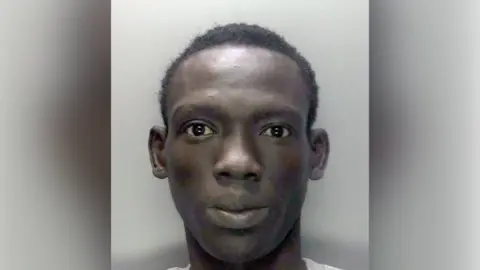
Deng Majek stabbed Rhiannon Whyte 23 times with a screwdriver in a frenzied 90-second attack in 2024 after following the 27-year-old to Bescot Stadium railway station in Walsall.
He was later caught on CCTV dancing and laughing.
As Majek was handed a minimum term of 29 years at Coventry Crown Court on Friday, his victim's mother wiped away tears.
Donna Whyte read out a statement at the hearing, her hands shaking as she looked directly at Majek - a Sudanese national - to say: "I hope you never see the outside world again. Let me see you dancing now."
She told the court it was "impossible to fully explain the pain I'm feeling", adding her late daughter had also been her best friend.
"Because of Majek's inexplicable, cruel and brutal actions, we must face life without her," she said.
"To some extent my life also ended that day. She had no chance, no say in how her life would be decided. You took that from all of us."
 PA Media
Rhiannon Whyte had just finished her shift at the Park Inn Hotel at 23:00 BST on 20 October 2024 and was on the phone to a friend as she walked to the railway station.
She was on the platform when Majek launched his attack, stabbing her 19 times in the head, with 11 injuries to her skull, and one wound so deep it pierced her brain stem.
She died in hospital three days later. No motive has been established for why Majek attacked her.

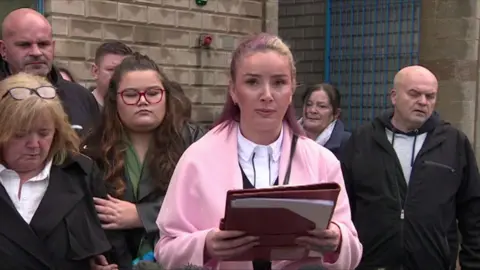
Outside court, Donna Whyte said she was "pleased" with the sentence but added that her family had "a life sentence too" because of Majek's actions.
"I will hate him till the day I take my last breath," she said, before adding that love for her daughter was stronger.
Rhiannon Whyte's sister Alex Whyte, also spoke on Friday. She told the sentencing hearing in a victim impact statement how she was now raising her late sister's son, saying it was "unimaginably difficult" to explain to him his mother had died.
"It is no exaggeration to say that his screams will haunt me forever," she said.
She added that her nephew wanted to be a "brain doctor" so he could save people with injuries like those of his mother.
She had previously described Majek as a "sick, twisted and cowardly human".
Outside court there were anti-immigration protesters, including far-right activist Tommy Robinson, who left shortly after the sentence was delivered, having addressed some of the crowd.
The judge Mr Justice Soole said Whyte had tried to defend herself "with the greatest courage" against Majek's "frenzied and sustained brutality".
She was found on a deserted platform minutes after the attack by a member of railway staff from the train on which Whyte had intended to travel home.
The court heard how Majek took Whyte's phone and turned it off, before walking calmly away and throwing the device into a river.
He then took a long walk around Walsall and bought beer, with CCTV footage showing him dancing and laughing in the car park of the hotel.
During sentencing, the judge told Majek - who arrived in the UK on a small boat about three months before the attack - that there had been "chilling composure in every aspect of your behaviour".
Before the hearing, the judge had ordered an age assessment report to be drawn up due to uncertainties over how old Majek was.
Majek himself had claimed to be 19, despite documents - filled in during a failed asylum claim in Germany - suggesting he was 27.
Sentencing guidelines are different for children under 18, but the guidance to judges reads "many of the principles will also be relevant to sentencing young adults (aged 18-25)".
The assessment report later concluded Majek was over the age of 21, with the judge saying he believed the defendant to be between the ages of 25 and 28.
The trial had heard how Whyte's blood was found on clothes, shoes and a ring worn by Majek.
When he was asked during those proceedings why he had her DNA under his right fingernail, he replied: "I never touched her, and there is no DNA."
The jury did not believe his evidence.
Follow BBC Birmingham on BBC Sounds, Facebook, X and Instagram.
