The physio helping to change children's lives on a floating hospital

 Mercy Ships
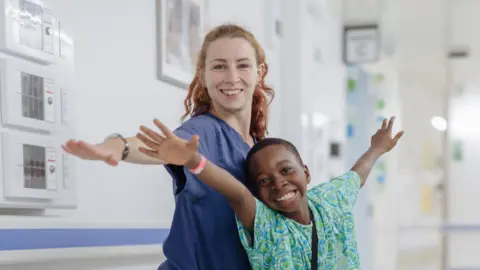
For the past eight years physiotherapist Laura Blundell has been using her annual leave to volunteer on a hospital ship in West Africa, working with the charity Mercy Ships to help children with painful, long‑untreated conditions learn to walk again.
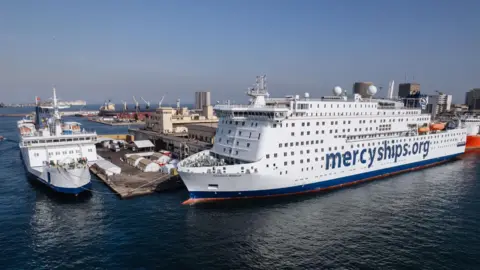
"My mind was totally blown by what I saw," said Laura, remembering the moment she first stepped onto the Africa Mercy, one of two ships operated by the charity, in 2017.
The two vessels have both been fitted out with operating theatres, recovery wards, intensive care units and rehabilitation spaces.
Laura, originally from Preston but who works at St James' Hospital in Leeds, joined the Africa Mercy in Cameroon.
Onboard she met children living with bone conditions that would be treated quickly in the UK, and adults with benign tumours that had grown for years because surgery was out of reach.
Access to surgery is limited in Cameroon, according to Mercy Ships there are only 1.15 surgeons for every 100,000 people meaning many people live with treatable conditions for years.
"I saw children in daily pain," Laura said.
"Some were ostracised because of conditions like rickets, burn patients could not move their arms, legs or even their necks because their injuries had never been treated."
 Mercy Ships
Mercy Ships rely on volunteers to keep their two hospital boats running.
Around 100 different professions are covered and at any one time there is a volunteer crew of at least 1,000 people.
Volunteers do not need medical training, only 50% of volunteers are medics.
Laura said having the opportunity to make a difference in the lives of "so many people" was "incredible".
"I have got a lot of skills in my tool belt," she said.
"Being able to use those skills to help people who would not have access to therapy, rehab or surgery, it feels like something that needs to be done."
 Mercy Ships
The physiotherapy team is one of the few on board that sees patients through their entire journey, starting with taking care of the pre-assessment of patients ahead of surgery.
"We take their measurements and talk about their life goals, whether that is going to school, playing football or being able to work," she said.
"After surgery, we see them with their casts on, we put the casts on a lot of the time, take them off, and then start the rehab process."
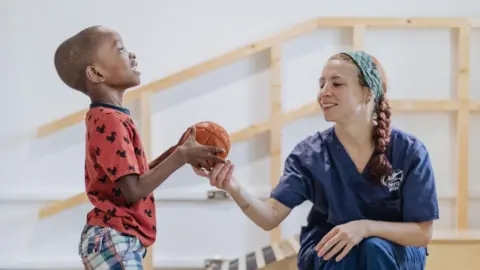
Rehabilitation focuses on helping children rebuild strength and learn new ways of moving after surgery.
Laura works patients through exercises and mobility practice as they recover.
"One of the most powerful changes is seeing each child grow in confidence," she said.
"Many of them have lived with the shame of being different.
"Their parents feel that shame too, as the rehabilitation continues, that shame falls away.
"Suddenly, there is hope for the future."
Listen to highlights from West Yorkshire on BBC Sounds, catch up with the latest episode of Look North.
