Remote community 'terrified' over school transport

 Family handout
Families in a remote village have claimed North Yorkshire Council is not prioritising their children's safety under its new home-to-school transport policy.
One father said the authority wanted his children to travel by taxi over a "single-tracked 20 degree gradient road" to one school, despite a bus to another school passing by the end of his drive.
Since September children starting school in the county only receive free bus passes to their nearest school, instead of the previous system of catchment areas.
North Yorkshire Council said the policy change was necessary to save money, adding that an appeals process was "available for families with exceptional circumstances".
By law, transport must be provided to those who live more than three miles away from a school, or two miles if the child is younger than eight.
The village of Oughtershaw, Upper Wharfedale, is "properly in the middle of nowhere", according to Laura, who moved to the village in 2022.
When her family relocated from East London in 2022, they knew a school bus travelled from their new home to primary school in Kettlewell, down the valley.
As a result, they registered four-year-old daughter Maeve there in November 2024.
However, Laura said she was "shocked" to find out in June 2025 that their application for free school transport was unsuccessful, as a school in Hawes is geographically closer.
The route to Hawes crosses Fleet Moss, the highest paved road in Yorkshire.
"Anyone who lives within the local area will tell you that no child has ever travelled over Fleet Moss to go to Hawes because it's treacherous," Laura said.
"It's not a safe road."
David's family also relocated to Oughtershaw from East London, with his daughter and son starting school in Kettlewell in September.
The existing bus from the end of their driveway was a "major motivation" for the family, as it would take seven-year-old Willow and five-year-old Ash to Kettlewell.
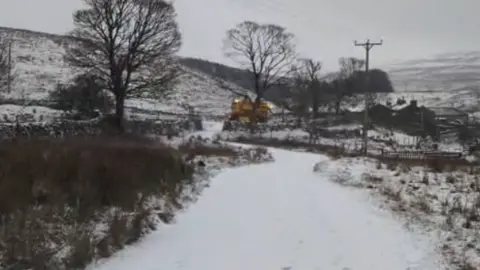
Their farm is at the foot of Fleet Moss, which David said had closed for more than a week since the start of the year because of snow and ice.
"It's a single track, 20 degree gradient road. It was deemed too dangerous for the Tour de France," he said.
"I would never send my children in a taxi with a stranger with no mobile signal over that road."
 Supplied
David said he and others had heard "assurances" from their local councillor that isolated rural communities like theirs were "exceptional" cases where the new school transport policy could be appealed through a "robust" process.
But, like Laura, his application for bus passes was refused and both families' appeals failed.
Whilst they could pay for bus travel, at £800 per child per year, David and Laura both said their children's spaces on the bus could be revoked.
"We were told in our stage two appeal that the bus routes would be stopping," David added, saying he did not want to pay for a pass out of "principle and security".
Instead, both families have made arrangements to drive their children to school.
David said he had had to "hugely" reduce his work hours as a self-employed psychologist as a result.
Laura's husband bought an additional car to replace his work van so he could collect Maeve at the end of the day, while Laura has changed her shift times as a hospital ward manager, she said.
'Won't save money'
At the moment, David said, the bus from the end of his driveway would continue to run to transport a neighbour who started school under the previous policy.
However, if Willow and Ash went to school in Hawes, they would be transported by a taxi, which would, according to David, drive from Skipton every day and cost the authority more than £20,000 per year.
He said a local taxi firm contracted to provide home-to-school transport had given him quotes of £35 for a one-way trip from Oughtershaw to Kettlewell, but £55 from Oughtershaw to Hawes.
"North Yorkshire have accepted that this would be the case," he said.
"In exceptional circumstances like our situation, it won't save money, it will increase the taxpayer burden."
Laura said she had been "gobsmacked by the whole process".
"It was mentioned in my stage one rejection that the safety of the road is not taken into consideration, which to me is North Yorkshire Council telling me that they do not care about the safety of the children of the local area," she said.
 BBC/Claudia Robinson
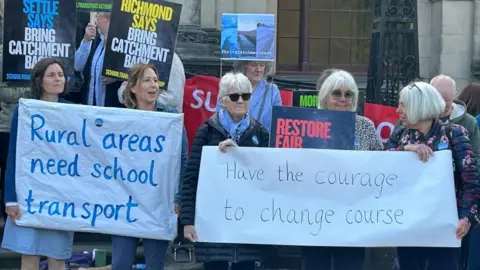
A campaign group set up to fight the policy change says North Yorkshire Council is now being investigated by a watchdog.
The School Transport Action Group says at least five families have been contacted by the Local Government and Social Care Ombudsman to say their complaints are being investigated.
It is understood that the complaints being investigated by the ombudsman relate to the council's decision-making and appeals processes, according to the Local Democracy Reporting Service.
Campaigners say questions had also been raised about mapping software used to determine a child's closest school, and that families' individual circumstances were not taken into account.
North Yorkshire Council said it recognised that families could "refer their concerns to independent bodies" and would "engage with any developments as we are required to".
Assistant director for education and inclusion, Amanda Fielding, said the policy, introduced in September 2024 following a council meeting in July 2024, ensured eligible children were transported to their nearest schools.
She added: "Parents and carers still have a choice as to where they send their children to school.
"We have a duty to provide transport to eligible children and we want to ensure this is in a safe, efficient and cost-effective way.
"Rising costs of delivering our home to school transport duties have now exceeded £52m making it one of the top three areas of the council's spending.
"This revised policy supports longer term sustainability."
Listen to highlights from North Yorkshire on BBC Sounds, catch up with the latest episode of Look North.
