Rare sighting of Orca group's last survivors off west coast of Scotland

 Ryan MacRae
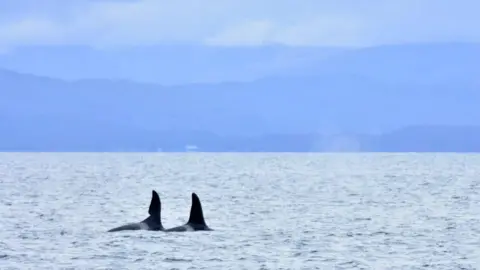
A sea life survey off Scotland's west coast has recorded rare sightings of what are believed to be the last surviving members of a group of UK orcas.
Known as the West Coast Community, the group numbered 10 animals in the 1990s and were frequently spotted around the UK and Ireland.
Since 2016 - when a female nicknamed Lulu was found dead in the Inner Hebrides - only two have been spotted, males called John Coe and Aquarius.
Hebridean Whale and Dolphin Trust (HWDT) said during its latest annual survey the bull killer whales were seen together including the Sound of Rum in September and off Skye in November.
HWDT described the sightings as one of the "standout encounters" in a record-breaking year for reports of marine animals.
 Indy Greene
Individual orcas can be identified by the shape, size and any notches and scars on their dorsal fins, which is the fin on top of their bodies, as well as markings on their black patches of skin.
Among John Coe's identifying features is an injury to his tail believed to have been caused by a shark bite.
HWDT said: "Among the year's standout encounters was the reunion of John Coe and Aquarius, the last known members of the West Coast Community of killer whales."
The trust said before they were spotted side-by-side earlier this year it had been almost five months since the orcas had been seen together.
John Coe is the name of a character in a novel called Mile Zero by Thomas Sanchez.
Nine years ago, Lulu was found dead on Tiree after becoming entangled in fishing lines.
Later analysis revealed she was contaminated with "shocking" levels of a toxic chemical called polychlorinated biphenyls, or PCBs.
The chemicals were banned from the 1970s but are still in the environment.
HWDT has been carrying out surveys of Scotland's west coast for more than 20 years.
It said more than 100,000 individual whales, dolphins, porpoises and other wildlife were recorded in 2025 - the survey's highest annual total so far.
HWDT said many of the animals would have been recorded more than once, as individuals and groups moved through Scottish waters and were seen by multiple volunteers over the course of the survey.
But the trust added that together, the reports provided a "powerful picture" of how marine species use Scotland's seas.
Other sightings included a beluga whale - a rare Arctic visitor - in Loch Broom near Ullapool and sunfish off Tiree and the Treshnish Isles.
Orkney 'nursery'
 Orkney Skate Trust
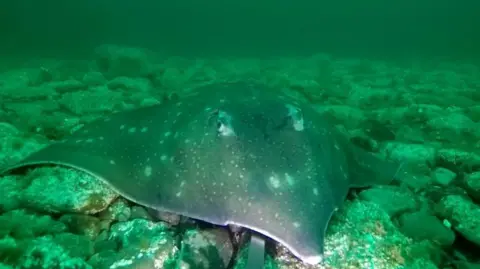
Meanwhile, the first breeding site for critically endangered flapper skate has been found in Orkney.
The skate can grow up to 2.4m (8ft) long and 2m (6ft) wide.
A total of 95 egg cases were found during survey work in Scapa Flow which was commissioned by Orkney Islands Council.
The discovery has led to an exclusion zone in the southern part of Scapa Flow to protect the nursery site.
Daniel Wise, of Orkney Skate Trust, said: "This discovery is fantastic news for Orkney and for flapper skate.
"Locally known as barndoor skate, this fish has a long history in Orkney."
A flapper skate nursery has previously been found off Skye.
