Volunteers ring falcon chicks to track future flights

 BBC
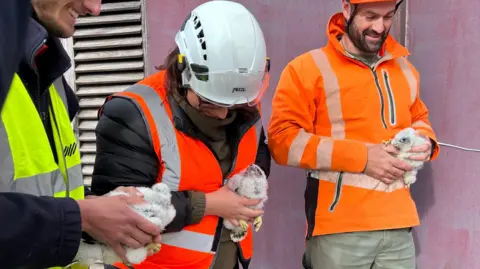
BBCVolunteers have climbed to the top of a Stafford office block to ring a nest of peregrine falcon chicks, in order to track their future movements.
The four chicks were born in a nesting box on top of the BT Telephone Exchange on Eastgate Street, and are about three weeks old.
The West Midlands Ringing Group care for about seven nests in the region, and ringing the birds allows them to follow them as they grow and travel.
The team also take DNA from the birds so they can monitor any thefts or unnatural deaths that take place.

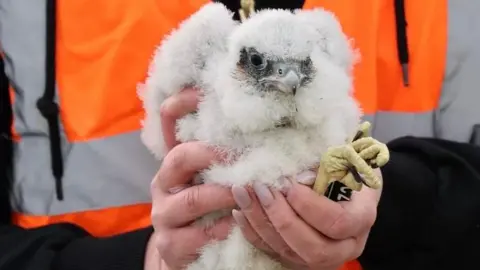
As well as a small metal ring, the volunteers put a larger, plastic ring on the birds legs, which can be easily spotted by birdwatchers, allowing for easier tracing.
Ben Dolan, from the West Midlands Ringing Group, says putting on the rings while they are are chicks is easier as they stay calm - with adults much easier to catch.
Finding peregrines in urban areas is now very common, as the group said tall buildings often provide a secure spot for breeding.
In Stafford, the birds have a nesting box, and a camera to monitor their movements, provided by the building's maintenance company CBRE.
According to the British Trust for Ornithology, birds ringed in the UK have been recorded as far afield as Morocco.
"We are able to see that we've now got breeding pairs in Liverpool or Halifax," he said.
"The chicks have gone from here, the parents have done a fantastic job, the birds have fledged, travelled, they've learned how to fly, learned how to hunt, they've travelled all around the world and now they're the parents. It's fantastic."
But Dolan said, many return to their birthplace and take over the nest they were born in.
These birds are expected to fly their nest in August.
 West Midlands Ringing Group
The volunteers' work to protect the birds is done outside of their day-to-day lives.
Dolan, has been ringing birds since 2010, but normally works as a police officer with West Midlands Police.
He was inspired after watching his daughter, Robin, and her interest in the birds in their garden.
"From that - gained my interest, I learned about them, she learned about them and that's how I got where I am today," he said.
Follow BBC Stoke & Staffordshire on BBC Sounds, Facebook, X and Instagram.
