Surfing champion on burnout: 'My body just shut down'

 Pete Hill
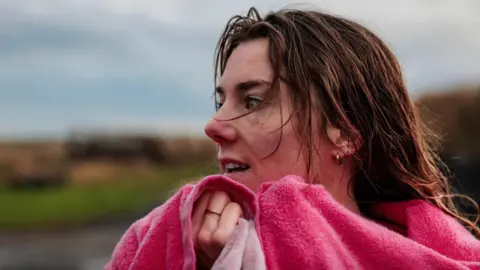
"I was in bed for I think about six weeks - I couldn't surf, I was just completely exhausted."
Lucy Campbell talks about how the sport she fell in love with as a child almost broke her.
Campbell, 31, is one of the most successful surfers England has produced, with eight national titles to her name.
But after a severe spell of burnout that left her exhausted, isolated and unable to train, she is setting a new course, on her own terms.
 @bellarosebunce
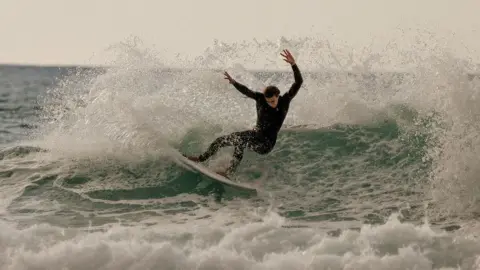
Campbell started surfing aged eight at Woolacombe in Devon and what began as copying her brothers quickly turned serious.
By her teens she was competing nationally, and at 18 she won her first open women's title. Faced with a choice between university and surfing, she committed fully to the sport.
For more than a decade, that decision paid off. Campbell travelled constantly, competed across Europe and helped prove that professional surfing could be a long-term career for women in England.
"There was a period of four or five years where I was not in one place for longer than about three weeks," she said.
"I loved it at the time, but it takes a huge toll on your body."
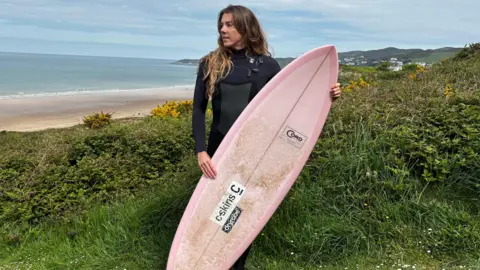
The breaking point came during the 2024 season. After one of her strongest competitive years, she felt close to a major breakthrough.
"I narrowly missed the podium at the European Championships and again narrowly missed podiums along the World Qualifying Series around Europe and I just thought next year it's gonna be my year.
"I felt like I'm in a really good place. I felt like I'm so close, if I just train that little bit harder, put in a little bit more work, I can get to those dreams that I've set myself."
When results dipped, she pushed harder. Instead, her body shut down.
"I had a month where I had a competition at the start and then I had a week with five different filming projects for brands, TV, various different things and then I had another competition and then an intensive training count with the Team GB over in Portugal again and I got to the end of that and I was just completely exhausted.
"I was in bed for I think about six weeks, I couldn't surf.
"My heart would be racing even when I was lying in bed," she said. "It felt like I had just been out for a run. I could not calm it down at all. My nervous system was in complete chaos."
 Pete Hill
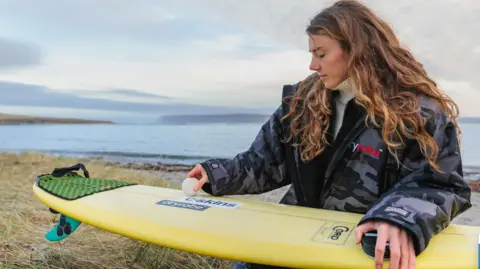
The impact spread beyond sport. Campbell lost sponsorships, struggled in her relationships and felt disconnected from herself.
"I felt numb," she said. "I was sort of acting like the person I thought I was meant to be, but I could not really show up for friends or family."
Doctors later suggested she may have been suffering from Relative Energy Deficiency in Sport, known as RED-S when sports people restrict their diet, burnout or another form of adrenal fatigue, but there was no definitive test.
What is burnout and what should I do if I think I'm in danger of becoming burnt out?
Burnout is recognised by the World Health Organization as an occupational phenomenon and is classed as a syndrome rather than a medical condition.
It is a state of physical, mental and emotional exhaustion caused by long-term stress and prolonged pressure that leaves people feeling detached, demotivated and hopeless.
If you are experiencing burnout, it is important to reach out to people you trust and seek support from your GP, who may offer time off work or refer you for counselling.
Understanding what has contributed to your burnout can help you identify changes you can make, whether at work or at home.
Source: Mental Health UK
 Pete Hill
Eventually, Campbell decided to step away from full-time competition.
"The constant travel was not good for me any more," she said.
"As hard as it was to admit, that was a turning point where I realised I needed to change direction.
"I think I've definitely got a competitive nature and I think that I was sort of driven by wanting to put British surfing on the map and wanting to showcase what incredible talent we've got here.
"Looking back I think that was perhaps a lot to put on my shoulders."
'Sustainable for your body'
Now living in Cornwall, she still surfs, films and occasionally competes, but on her own terms. Last year she entered the English Nationals with no expectations and won, a result she says showed how damaging pressure had become.
"I thought it'd be nice to go down to see the community and surf some heats, have some fun. I was over the moon about winning, but I think it does just show what happens if you do sport for the love of it and in a way that is sustainable for your body."
She has also begun speaking openly about burnout, keen to help others avoid the same experience.
"The more people I talk to, the more I realise how common this is, not just in sport," she said. "If speaking about it helps one other person spot the signs early, it is worth it."
Her advice to young surfers: "Treat surfing like a job if you want it to become one," she said. "But you also have to switch off. It is not lazy to rest. Rest is part of training."
Overlooking the beach where it all began, Campbell says stepping away from competition helped her rediscover what mattered most.
"The thing I noticed the most when I was going through burnout is that I've always just loved getting in the ocean every day and I'm so grateful that that's my job.
"Losing your love for the sport is the biggest warning sign," she said. "Listening to my body saved my relationship with surfing."
