Hospital 'in good shape' to cope with city growth

 Amy Holmes/BBC
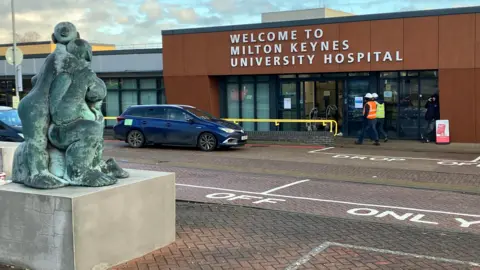
A hospital chief executive has said its building is "in relatively good shape physically" to cope with the rapid growth of the city it serves.
New wards and an imaging centre are due to open at Milton Keynes University Hospital in March, and an additional building featuring new maternity and children's services is expected by 2032.
The population of Milton Keynes could grow to more than 400,000 by 2050.
CEO Joe Harrison said he and senior managers were responsible for making sure the hospital was fit for purpose for the "next 50 to 100 years".
The government says the additional Milton Keynes hospital building will be the first of its 2.0 designs, as part of its New Hospital Programme.
Construction is due to start as early as 2027.
 Luca Felice/Milton Keynes University Hospital NHS Foundation Trust
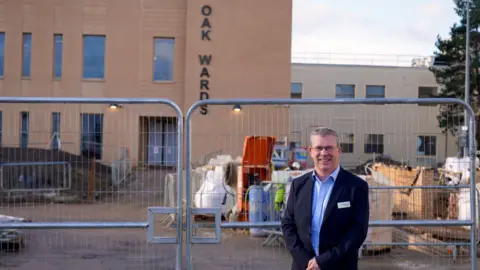
Milton Keynes University Hospital was built in 1984 and Harrison has been CEO since 2013.
He was appointed CBE for services to healthcare in the 2025 New Year Honours.
Things were "on track", Harrison said, when it came to "developing clinical services in and around Milton Keynes."
However, the real challenge was that "government funding is running roughly two years behind any growth agenda so we are always trying to catch up on the money".
The new building promises additional surgical bed capacity, as well as the new space for maternity and children's services.
In the meantime, Harrison pointed out that new satellite units had opened - a health centre on the Whitehouse Development and a community diagnostics centre at Lloyds Court in central Milton Keynes.
Growth in Milton Keynes: The numbers
- On average, between 1,800 and 2,000 homes are expected to be built per year in Milton Keynes between now and 2030
- New developments include 5,500 homes at Milton Keynes East, 4,300 on the Whitehouse development and between 3,000 and 3,500 in the south east of the city
- The estimated population of Milton Keynes was 292,200 in 2022, but could rise between 382,300 and 410,000 people by 2050, depending on housing targets
- Milton Keynes is one of 12 potential locations listed by the government's New Towns Taskforce, with aspirations for a new mass rapid transit system
 Amy Holmes/BBC
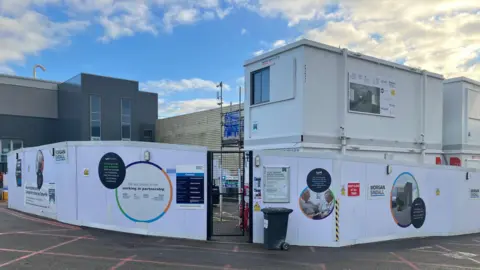
In March, the Oak Wards will open at the hospital.
They are made up of two 24-bed facilities with a focus on frailty and dementia care, and portacabins will be replaced with purpose-built units for CT, ultrasound and MRI services.
When questioned on the state of the hospital's accident and emergency services, Harrison felt it was "OK in terms of space".
He said constructing a new unit would be challenging because "you cannot just close the A&E department for nine months to build around it".
Asked whether the hospital needed a complete rebuild to meet the rapidly increasing population, Harrison replied: "At the moment I can't envisage a second hospital because I don't see the need."
He pointed out that other hospitals in the area, such as Northampton and Stoke Mandeville, were also "looking to ensure" they could cope with population growth.
"The challenge for us will be to make sure that as medicine improves and evolves, the care here in our hospital evolves accordingly," he continued.
"There's never a day that goes by when we can sit back and say job done. And that's the exciting part of it."
Follow Beds, Herts and Bucks news on BBC Sounds, Facebook, Instagram and X.
