Owners 'hunting high and low' for missing wallaby Sheila

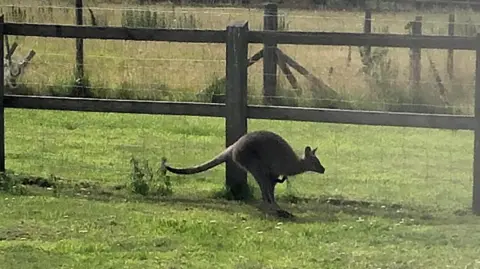 Kerry Hood
- Sheila, a brown wallaby, has disappeared from a farm near Norwich, Norfolk
- She was last spotted on Sunday but there have been reported sightings
- Her owner has asked the public not to approach her as she may panic
The owners of a missing wallaby are warning the public not to approach her as it may cause her to panic.
Sheila, a brown wallaby, was last seen at a farm in Keswick near Norwich, Norfolk, on Sunday.
There have been a number of reported sightings in the area in the last two days.
"Best not try and catch her," said owner Kerry Hood.
"Not because she’ll do anything to harm anybody but she’ll panic and may jump towards you or jump towards a car.
"Something like that."
She added: "We’re hunting high and low, but because she's a brown wallaby she’s quite hard to see."
Wallabies are small to medium-sized marsupials that are primarily found in Australia.
They have powerful hind legs that they use to travel at high speeds or when under threat by predators.
Sheila lives on a farm alongside pygmy goats, emus and another wallaby called Bruce.
Ms Hood said Sheila said she suspected "foul play" as Sheila had never disappeared before and another animal had been tampered with.
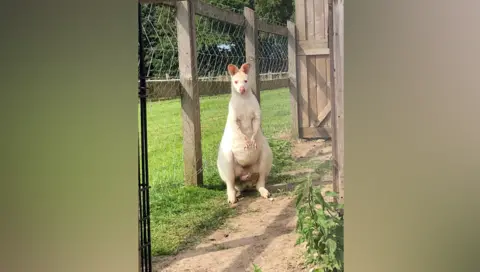 Edd Smith/BBC
Two people contacted BBC Radio Norfolk on Tuesday to say that they had spotted a wallaby on the loose in Keswick.
Nicky, a roofer, said: "I saw what I thought was a deer or a very large hare, and then it stood up on its back legs and I thought that 'looks like a kangaroo or a wallaby'.
"It had a long tail - about three feet long - and I was like 'what have I just witnessed.'"
Follow East of England news on Facebook, Instagram and X. Got a story? Email eastofenglandnews@bbc.co.uk or WhatsApp us on 0800 169 1830
