Developers can now bypass Epping council - what does this mean?

 EPA-EFE/REX/Shutterstock
Developers have been told they can "bypass" Epping Forest District Council when seeking permission for major projects.
Epping, in Essex, was one of nine local authorities on Monday to be stripped of its powers to determine large-scale builds.
It followed concerns about the "quality of decision-making" raised by Steve Reed, the Secretary of State for Housing, Communities and Local Government.
The council's Conservative leader has branded his intervention an "attack on local democracy", while opposition party Reform UK said residents were paying the price for "years of poor decision-making".
What does the decision mean?
 Reuters
It means Epping Forest District Council may no longer have a say in major projects across its jurisdiction.
Instead, developers can go straight to government-appointed planning officials when seeking approval for major developments.
The council's local plan states 11,400 new houses are needed across the district by 2033.
But Reed found it had not always been "adequately performing" its function of determining planning applications for these big projects.
Under the Town and Country Planning Act 1990, councils are penalised if more than 10% of their total application decisions are overturned on appeal - which has happened in Epping.
Major development is defined as:
- For housing, development where 10 or more homes will be provided, or the site has an area of at least 0.5 hectares (1.23 acres)
- Building/s where the floor space to be created is 1,000 square metres or more
- Development carried out on a site having an area of one hectare or more (2.47 acres)
What has the reaction been?
 PA Media
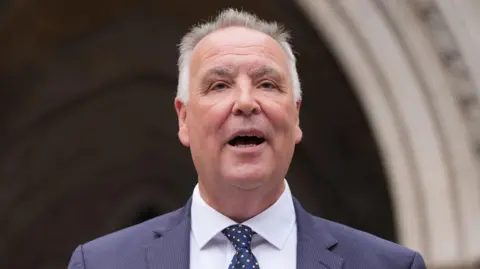
Chris Whitbread, the Conservative leader of Epping Forest District Council, calls it an "attack on local democracy".
"We understand the pressure from government to build more houses, but we also represent the interests of residents already here," he says.
"Councillors support good planning applications, but there is often a fine line between meeting the ambitions of developers and the needs of the community."
Whitbread says residents will be the "biggest losers", claiming developers can now "bypass local democracy".
However, he has been criticised by Jaymey McIvor, the leader of Epping's Reform UK group.
He says: "Thanks to the planning department being in special measures, Epping Forest's greenbelt is now a free-for-all.
"So much for a local plan protecting us from urban sprawl."
In a statement, Reform adds the government intervention was "a damning indictment" of how the local Tories handled planning matters.
A 'classic conflict' of democracy
 Peter Walker/BBC
Paul Whiteley, an emeritus professor of government at the University of Essex, says the situation is a "classic conflict" between local and national democracy.
"People who want to hold up development - and this area has lovely greenbelt land - are perfectly entitled to and they elect people who will support them," he says.
"The protesters will talk about local democracy being taken from them and isn't it terrible.
"But, nationally, people voted for a government that wants to build lots of houses.
"You could argue national democracy overrides local in certain circumstances."
It is not the first time a decision like this has been made in the East of England.
St Albans City and District Council's planning department was put into special measures between March 2024 and 2025.
Other councils designated under the 1990 Act on Monday included Dacorum and Hertsmere borough councils, both in Hertfordshire.
Together with Epping, they will remain under special measures at the government's discretion.
Do you have a story suggestion for Essex? Contact us below.
Follow Essex news on BBC Sounds, Facebook, Instagram and X.
