Glass centre architect says building should be saved

 BBC
BBCThe architect behind the National Glass Centre (NGC) has said the building was made to last and should be saved.
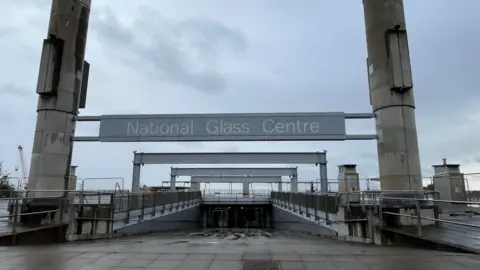
Andy Gollifer visited the venue in Sunderland on Thursday and said the thought of the centre being demolished was "extraordinary".
The NGC, which opened in 1998, is set to close in July over "unaffordable" repair costs, put at put at between £14m and £45m.
Site custodian University of Sunderland has said no individual or organisation has come forward to offer financial support towards rescuing the centre.
But Gollifer has rejected suggestions it could cost up to £45m to repair the building he designed - saying it would cost less than that to build a brand new site.
He said that while the NGC needed "attention", the structure was "robust" and made to last.
"If you were to take the site next door and build it all again, you'd be spending about £16m," he said.
He added: "There's no reason why it couldn't adapt. It's flexible, the interior could be moved around."
A spokesman for the University of Sunderland said it had commissioned a "full, up-to-date, independent building survey" in 2022, where external specialists concluded that a multimillion-pound investment would be required to address the longstanding problems with the building.
"The total cost of all the recommended remedial work was, based on independent advice, a minimum of £14m, and more likely nearer £45m," he said.
"The report suggested there may be alternative replacement roofing options which could potentially reduce the total cost by between £2.5m-£4.5m.
"However, after careful consideration, the Board of Governors decided that none of the options outlined in the building survey report were affordable given that the bulk of the university's income comes from student tuition fees and is spent on its core priority activities of learning, teaching, research, innovation, and knowledge exchange."
'Strong building'
The NGC building and land has been owned and managed by the university since 2010.
It previously said it had "spent millions of pounds" on the facility's upkeep and had subsidised its operating expenses by about £800,000 a year.
A replacement facility, Glassworks, has been proposed in the city's Sunniside area.
But Gollifer said the original building should be saved.
"I was expecting the worst, because I know there's been a certain amount of neglect, shall we say, but I'm actually quite surprised," he said after his visit.
He said the facility was "vibrant" and "you think to yourself how can that be, that it could be demolished".

"It's an extraordinary thought and I think there's a real shock to come to terms with that, but there's also a principle at stake," the architect said.
"You've got a public facility and those things don't get created easily.
"Somebody needs to redecorate it, and look after it, and love it."
Roger Clubley, who was part of the now defunct Tyne and Wear Development Corporation and helped bring the NGC to Sunderland, said the repair estimates were not "credible".
"It's a very strong building. It was also put together with the full recognition that this is a maritime climate, which makes things decay quicker," he said.
Clubley added he would be "gutted" if the building was knocked down.
"It's so fundamentally part of Sunderland," he said.
A spokesman for the university added the institution had been transparent about its decision making about the NGC.
He said the university had been subsiding the day-to-day running costs of the NGC "to the tune of £800,000 per annum" which was "clearly unsustainable".
"Whilst we appreciate the strength of feeling in some quarters about protecting and preserving the NGC, it must be said that, to date, no individual or organisation has come forward to offer any feasible plan of financial support towards refurbishing or saving the building on the scale that would be necessary," he added.
