'There's an absence of my story in the world'

 MUBI
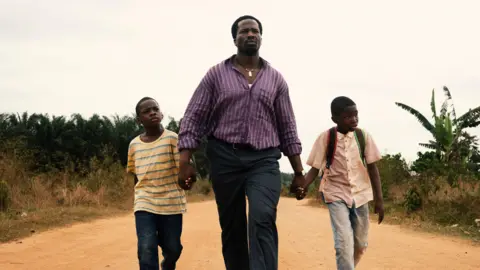
MUBIBritish-Nigerian director Akinola Davies Jr says moving from Lagos to Kent as a teenager made him determined to share his story.
He said life in the UK opened his eyes to misconceptions about Nigeria.
Davies' debut feature film, My Father's Shadow, has been released in UK cinemas to critical acclaim.
Inspired by his childhood in Nigeria and written by his brother Wale Davies, it explores family relationships against the backdrop of the tumultuous 1993 election.
Davies went to Cranbrook School in Kent and then studied English language with Media Studies at the University of Brighton.
"[It] showed me there's an absence of my story, an absence of the Nigeria I grew up in," he said.
Diverse stories
Davies said he and his brother are aiming to break down stereotypes and share their experiences with the world.
Davies said many scenes in the film echo his personal memories of the military unrest on the day of Nigeria's 1993 election.
On 12 June 1993, presidential elections were held for the first time since a military coup 10 years earlier.
Moshood Kashimawo Abiola, of the Social Democratic Party, gained the majority of votes.
However, before the result was announced, the then-military president General Ibrahim Babangida annulled the election, leading to violent protests throughout Nigeria.
 MUBI
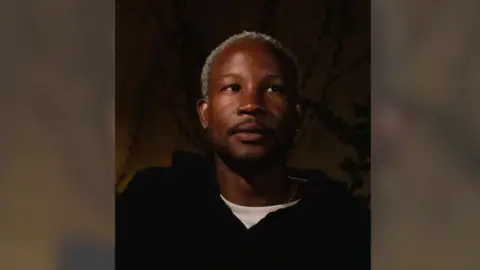
MUBIDavies said many scenes in the film echo his personal memories of the military unrest on the day of the 1993 election.
"We got pulled out of school, and driving home we had to put a branch on our car to show we weren't part of the military and to get safe passage," he recalled.
With history lessons restricted until the late 1990s in Nigeria, Davies believes the film could help younger Nigerians learn about their national history.
"As a community we don't really talk about collective grief or collective trauma.
"This film presents a bridge for both generations to connect and for people to understand what their parents went through."
As well as helping him to share his own voice, Davies said moving to Brighton in the early 2000s opened his eyes to other diverse stories.
"Brighton gave me an opportunity to see how big and beautiful the world is," he said.
He said he met people from different communities that he never knew existed.
Follow BBC Kent on Facebook, on X, and on Instagram. Send your story ideas to southeasttoday@bbc.co.uk or WhatsApp us on 08081 002250.
