Prehistoric tools unearthed near major road

 Oxford Archaeology
Archaeologists have dug up prehistoric artifacts while helping prepare a major dual carriageway for roadworks.
The two-year project will see the junction at Lodge Hill on the A34 in Oxfordshire widened to help prevent traffic jams.
Investigations uncovered deeply buried sediments from north Abingdon's ancient river systems, dating back to the Middle Pleistocene period.
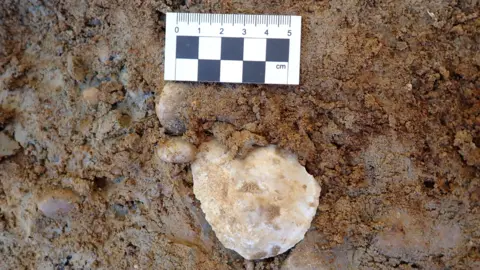
Other discoveries included three flint tools - thought to be a sign of an early human presence from the Neolithic or Bronze Age period.
 Oxford Archaeology
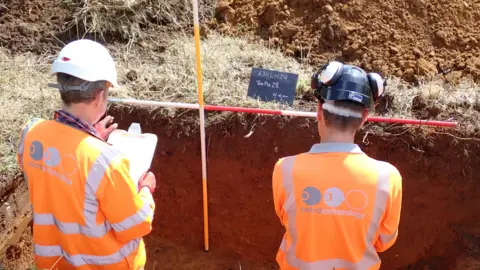
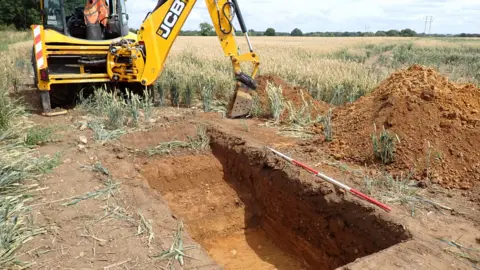
The work was part of a planning condition to explore any potential archaeological remains or ancient sediments that could be affected by the roadworks.
Excavations by Oxford Archaeology found evidence of the Lodge Hill Channel, an ancient river system that crossed the site in a southwest to northeast direction.
Buried beneath a younger layer of gravel, the channel has silty sediments up to 5m (16ft) deep in places, with remains of ancient fossil material such as snail shells, fish bones and plant matter in its deeper parts.
A piece of a Palaeolithic flint handaxe was also uncovered, along with Roman pottery and medieval tile fragments.
 Oxford Archaeology
Francis Wenban-Smith, palaeolithic specialist for Oxford Archaeology, described the findings as "exciting".
"Artefactual evidence of this period is exceptionally rare in the Upper Thames landscape north of the Goring Gap," he said.
"The presence of flint tools gives an insight into the mobility of these ancient humans, since flint raw material would not have been available at the site."
Carl Champness, the project's manager, said it was "only the start of the story".
"We hope planned further investigation and detailed analysis of these remains, will help enhance our understanding of the early occupation of Britain,” he added.
No major archaeological remains were identified, according to Oxfordshire County Council, meaning the £17m project will now go ahead.
Main construction is due to start in spring 2025 and will see the road widened to improve capacity, with new south-facing slip roads built.
You can follow BBC Oxfordshire on Facebook, X (Twitter), or Instagram.
