South Africa's exclusion from G7 summit no surprise, says Ramaphosa

 Reuters
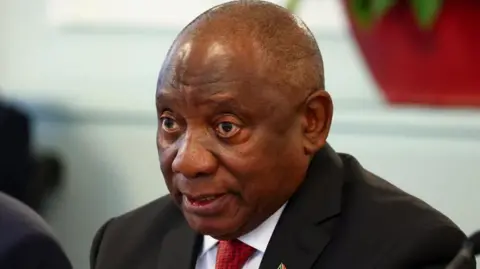
South African President Cyril Ramaphosa has downplayed reports that his invitation to the forthcoming G7 summit in France has been withdrawn, saying non-attendance by a country outside the bloc should surprise no-one.
Reports on Thursday claimed the US had put huge pressure on France to rescind Ramaphosa's invitation to the summit scheduled for June. They claimed US President Donald Trump had threatened to boycott the summit if the South African leader attended.
"The invitation to the G7 does not mean that you're being snubbed if you're not invited or you're being ignored," said Ramaphosa.
France has, however, denied yielding to any US pressure, saying it had decided to invite Kenya this time.
France, which holds the presidency of the Group of Seven (G7) industrialised nations, said on Thursday it would host leaders from South Korea and three other non-member countries - India, Brazil and Kenya - at its annual summit in Évian-les-Bains.
It said the invitations were part of efforts to "correct global economic imbalances".
A South African official said on Thursday it had been excluded from the summit after initially being invited, citing "sustained pressure from the US".
"They couldn't risk missing a key member of the G7, hence the withdrawal of their invitation, which President [Emmanuel] Macron personally extended to President Ramaphosa last year during the G20 summit here in Johannesburg," said Vincent Magwenya, the presidency spokesperson.
But a few hours later, Ramaphosa said that according to "his information" there had been "no pressure from any country".
"So many countries around the world don't get invited to the G7, and we are not a member. When we do go, we are invited, and we take a message there," said Ramaphosa, who has previously attended several G7 summits as a guest of the host nation.
He added that South Africa had not attended every G7 summit and that if they do not attend the June summit, "it should come as no surprise to anyone".
French Foreign Minister Jean-Noel Barrot told the AFP news agency that his country had "not yielded to any pressure" but had opted for a "streamlined G7," inviting Kenya instead to help prepare the France-Africa summit in Nairobi in May.
"We have not asked the French to exclude South Africa from the G7 Summit," a State Department official told the agency.
A White House official told Reuters that the decision to invite Kenya came after talks among G7 members.
Macron is due to visit Kenya in May for the two-day Africa-France summit.
Relations between the US and South Africa have deteriorated since Trump took office last year, with the two sides clashing over trade, diplomacy and South Africa's strategic partnerships.
Trump has been openly critical of Ramaphosa's government, accusing it of failing to protect the country's white minority and criticising its land reform plans.
The South African government, meanwhile, has criticised the US decision to prioritise refugee applications from white Afrikaners, saying claims of a white genocide have been widely discredited and lack reliable evidence.
Tensions deepened last year when the US imposed the highest tariffs of any African country on South Africa.
Earlier this month, South Africa summoned the new US ambassador Brent Bozell to explain his "undiplomatic remarks" about Pretoria's racial policies and court decisions.
Bozell appeared to later backtrack, saying the US government respected the independence and findings of South Africa's judiciary.
On Thursday, the South African presidency spokesperson said the "process to reset the relationship with the US remains ongoing".
"Our bilateral relationship with France remains strong and will not be impacted by their withdrawal of the invitation to attend the G7 Summit," he added.
More about South Africa from the BBC:
 Getty Images/BBC
Go to BBCAfrica.com for more news from the African continent.
Follow us on Twitter @BBCAfrica, on Facebook at BBC Africa or on Instagram at bbcafrica
