How are countries responding to hantavirus?

 Reuters
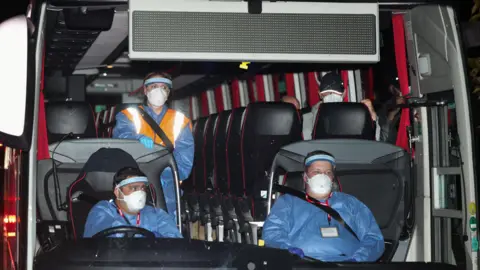
The last passengers and some crew members have now left a Dutch cruise ship at the centre of an outbreak of hantavirus, after disembarking at Granadilla port in south-east Tenerife.
Dozens of passengers from all over the world have been making their way home.
Three people - a Dutch couple and a German woman - had died after travelling on the ship, with two of them confirmed to have had the virus. The WHO has so far reported nine cases in total, seven confirmed and two suspected.
An American and a French national who had returned home have since tested positive, authorities said, while a Spaniard has a suspected case.
Here's how countries are dealing with the virus:
UK
Twenty British nationals, one German national who lives in the UK and one Japanese passenger arrived at Arrowe Park Hospital in Merseyside, north-west England late on Sunday.
They will remain in hospital for 72 hours to receive medical checks and regular testing, before being allowed to return home where they must self-isolate for a further 42 days.
The group was flown to Manchester Airport on a chartered flight, with the UK's Health Security Agency (UKHSA) saying "strict infection control measures" were in place throughout the journey.
Public Health Minister Sharon Hodgson said none of the passengers were symptomatic, but they will be monitored closely "as part of a precautionary isolation period".
"With no cases or symptoms among them and our stringent monitoring and isolation measures, the risk to the public remains extremely low," she added.
A total of 31 British nationals - a mix of passengers and crew - set sail on the cruise. Some disembarked before the first confirmed case of hantavirus was reported on 4 May.
US
Eighteen American passengers have returned to the US.
Sixteen of them, including a dual UK-US -national, are being screened at the University of Nebraska Medical Center in the city of Omaha and two are in Atlanta.
Two passengers, including one who displayed mild symptoms and travelled back in the charter plane's biocontainment unit, are being cared for at Emory University's Regional Emerging Special Pathogen Treatment Center in Atlanta, the United States Department of Health and Human Services (HHS) says.
HHS has advised the general public that the risk to them is "very, very low".
Four California residents who may have been exposed to the virus are being monitored, state health officials said on Monday.
Three of those people were aboard the MV Hondius cruise ship, while the fourth may have been exposed during an international flight, the California Department of Public Health (CDPH) has said, according to the BBC's US news partner CBS.
"The risk to public health of California remains extremely low," the CDPH added.
John Knox, of HHS, said on Monday that the returning Americans would undergo various health assessments over the coming days. They will then receive individual care plans, outlining whether they should isolate at home or if they need to remain at a facility, based on their condition and living situation.
A document from the Centers for Disease Control and Prevention (CDC) says people should self-isolate and be monitored for 42 days, during which time they should take their temperature once a day.
Netherlands
The EU's guidance is similar to the UK's, with citizens returning to their respective member nations advised to "undergo medical triage by trained healthcare professionals".
They should then self-isolate and monitor their symptoms for six weeks, seeking immediate medical help "if symptoms develop", according to advice from the European Centre for Disease Prevention and Control (ECDC).
In the Netherlands, Dutch nationals who left MV Hondius on Sunday were flown to Eindhoven, and are now completing their quarantine period.
They were transported in vans directly to their home addresses, the government said, adding that those in isolation would be contacted daily by the relevant health officials "to ensure that any symptoms are identified and appropriate care can be provided promptly".
Thirteen Dutch nationals - eight passengers and five crew members - were on board the ship when it docked in Tenerife.
Spain
Fourteen Spanish nationals flown from Tenerife to Madrid are undergoing mandatory quarantine at a military hospital in the capital.
On Tuesday, Spain's health ministry said one of the 14 had tested positive for hantavirus after previously receiving a provisional diagnosis.
The passenger has a "low-grade fever and mild respiratory symptoms" but is in a stable condition, the ministry added.
"The individual remains isolated, asymptomatic, and in good general condition," Health Minister Mónica García said.
The remaining 13 Spanish nationals tested negative, the ministry said.
Residents of Tenerife, and the Canary Islands in general, had expressed concern about the ship stopping there. But WHO officials insisted that the risk of wider contagion was low "because of how the virus works".
Passengers and crew leaving the ship were ferried to Granadilla port, well away from residential areas.
France
The country has confirmed its first case of hantavirus after a French national developed systems while travelling on a chartered flight from Tenerife to Paris.
French Health Minister Stéphanie Rist said a woman was isolating in Paris and her health was deteriorating, with 22 contact cases traced.
French PM Sébastien Lecornu had said over the weekend that all five French citizens travelling back from Spain would be "immediately placed in strict isolation until further notice".
Germany
German health authorities said on Monday that four people had arrived in the country overnight and were monitored in an isolation unit at Frankfurt University Hospital.
The country's health ministry has said all four, who are not currently showing symptoms, were being transferred to their homes in Berlin, Baden-Wuerttemberg, Bavaria and Schleswig-Holstein.
They will be "continuously and closely monitored for symptoms," Germany's federal health ministry said.
Local health authorities will decide on the specific measures to be taken.
Canada
In total, six Canadians were on the ship, authorities have said. Four returned to British Columbia on Sunday after boarding a chartered flight from Tenerife.
They have not shown any symptoms, but will be self-isolating for at least 21 days as a precaution. The Public Health Agency of Canada has said this could be extended to 42 days, citing the hantavirus's incubation period.
It can take anywhere between one and eight weeks for symptoms to appear.
Two other Canadians - a couple - are self-isolating at their home in Ontario. Health Minister Sylvia Jones said on Monday that neither has developed symptoms.
Switzerland
A man who left the cruise in Saint Helena has tested positive for hantavirus since returning home.
The Swiss national is receiving care and his wife, who was travelling with him, has not shown any symptoms of the virus but is self-isolating as a precaution.
The risk to the public in Switzerland is low, the Federal Office of Public Health said in its most recent update.
Argentina
Investigations are ongoing into how the outbreak started and if it originated in Argentina, where the ship began its journey.
The WHO has previously said the first two cases had "travelled through Argentina, Chile and Uruguay on a bird-watching trip which included visits to sites where the species of rat known to carry the virus was present".
Some Argentinian officials have said that is their leading hypothesis, but nothing has yet been confirmed.
The Andes strain of the virus, which is behind this outbreak, is mostly found in Argentina and Chile.
Philippines
Among the crew of the MV Hondius are 38 people from the Philippines.
There are currently no recorded cases of hantavirus in the country, with officials saying the risk remains "extremely low".
Additional reporting by Nadine Yousif
